Asparagus Season Is Coming: The Treviso Markets Where Locals Shop Before the Tourists Arrive
At some point in early April, something changes at the Pescheria.
The fish market — the one on the island in the middle of the Cagnan Grande canal, under the arched portico that has been sheltering vendors and buyers since the sixteenth century — begins to look different on Saturday mornings. The display that ran through February and March, dominated by radicchio in its final weeks, the last Tardivo of the season standing upright in its bundles like a small red regiment, starts to give way to something paler and more surprising. The first asparagus of the year appears on the stalls — not the thick, pale, almost ghostly white asparagus that will arrive in abundance by late April, but the early green shoots, slender and sharp-tipped, sold by the bunch with the soil still visible near the base, cut that morning from the fields southeast of the city.
This is what I look forward to most about April in Treviso. Not the longer days, not the change in the light on the canal water, though both of those things are real and welcome. What I look forward to is the return of the asparagus, and with it the particular character of the Trevisan market in the weeks before the tourist season establishes itself and the city begins to perform for an outside audience. April in Treviso — especially April before Easter, and the two or three weeks that follow — is the city at its most honestly local. The markets are full of things that were grown within twenty kilometres of where you are standing. The people buying them are the people who live here.
I am Igor Scomparin. I have held an official Tour Guide License for the Veneto region since 2007, and I have been buying asparagus at Treviso’s markets since long before most of my visitors knew there was more than one variety. This article is my attempt to explain what happens here in the weeks when asparagus season opens, where to find the best of it, and why getting here before the crowds — before late May, before the Venetian day-trip overflow reaches critical mass — matters for the quality of the experience.
Why the Veneto Produces Four Different Asparagus
Let me begin with something that surprises almost every American visitor who comes on a market tour with me, because it surprised me too when I first understood it properly: the Veneto does not produce one asparagus. It produces four, each of them a distinct Protected Designation product, each grown in specific soil conditions that cannot be replicated elsewhere in the region, and each carrying a taste and texture profile that differs meaningfully from the others.
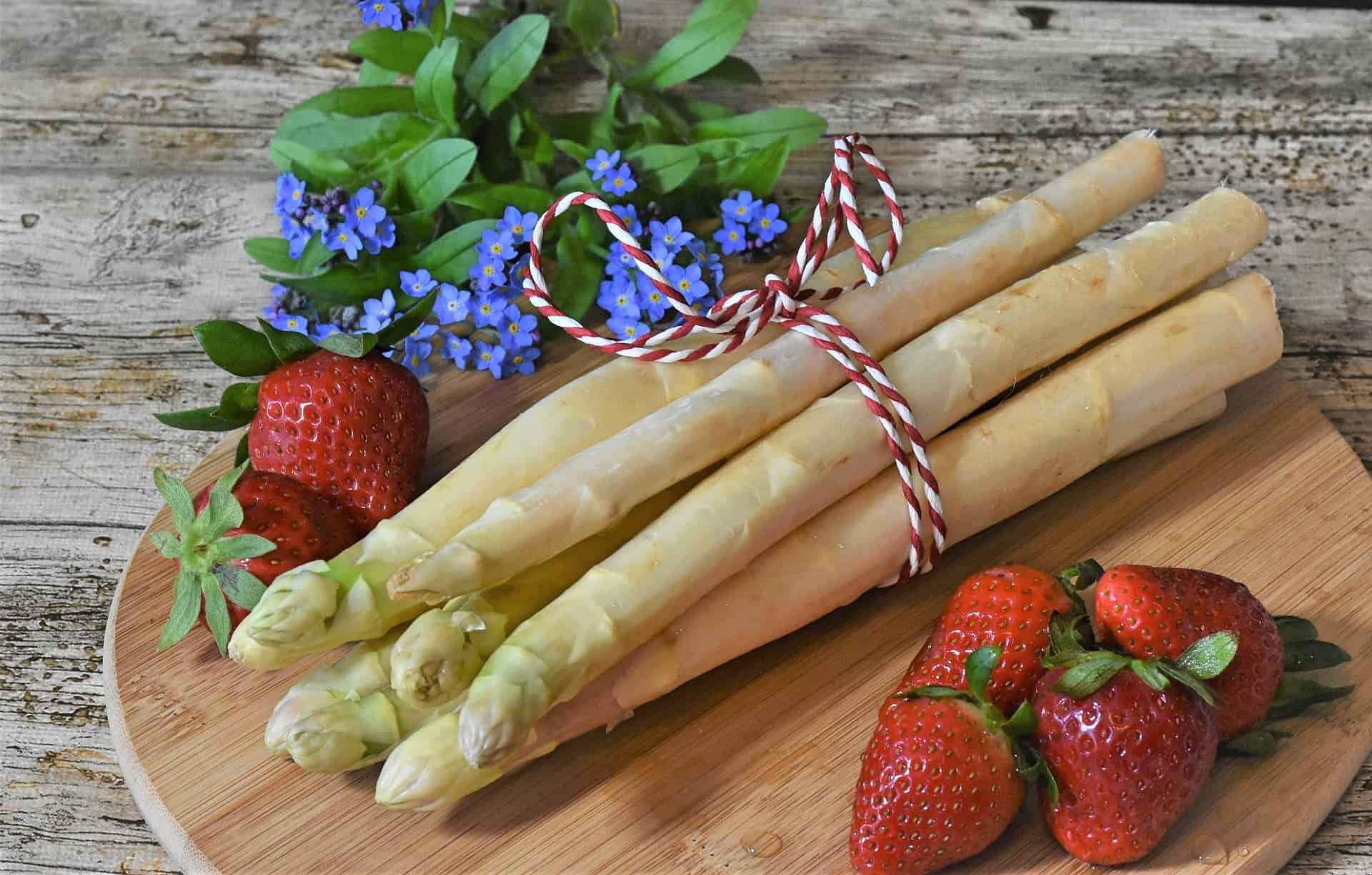
The first thing to understand is the difference between white asparagus and green asparagus, because in the Veneto this is not a cosmetic distinction but a fundamental one about how the plant is grown. White asparagus is not a different species. It is asparagus that has been kept underground throughout its growth, protected from sunlight by mounds of earth and dark covering sheets so that photosynthesis cannot begin, so that the spear emerges white rather than green, with a flavour that is more delicate and sweeter than its surface-grown counterpart and a texture that is almost buttery when properly cooked. The technique requires daily manual harvesting — each spear is cut individually, by hand, with a specialized curved knife, often before dawn or at dusk when the temperature is lower — and it is this labour intensity that partly explains why Veneto white asparagus is priced as it is and why the season matters so much.
The Asparago Bianco di Bassano DOP is the oldest and, to many palates, the most refined. It is grown in a tightly defined zone of ten municipalities around Bassano del Grappa, in the province of Vicenza, on soils that the regulation describes with precision: well-drained, low in clay, with specific mineral characteristics shaped by the Brenta River. The Bassano asparagus is whiter than white — it is white with pink-rose tones at the apex — and its flavour is distinctly sweet with a controlled bitterness that makes it among the most complex of the white varieties. The Consortium that governs the DOP has been in place since 1980, and the cultivation rules are strict enough that a spear found to have begun lignification — the process by which asparagus becomes fibrous and tough — cannot be sold under the designation. Bassano is forty-five minutes from Treviso by road. In season, you find it at Treviso’s Saturday market. It is one of the great Italian vegetables and it receives, outside this region, almost none of the international recognition it deserves.
The Asparago Bianco di Cimadolmo IGP is the one I consider most specifically Trevisan. It is grown along the left bank of the Piave River — the same river that gave its name to the Battle of the Piave, that flows south from the Dolomites through Belluno and Treviso toward the Adriatic — in eleven municipalities that are all within the province of Treviso. The sandy, silty, perfectly drained alluvial soils of the Piave plain create conditions for asparagus growth that produce spears with an unusual tenderness and a flavour that the regulation describes as fresh and delicate, almost without the bitterness that characterizes other white varieties. The “Strada dell’Asparago” — the Asparagus Road, a network of producers, restaurants, and local municipalities established in 2006 — runs through this territory and organizes events each April and May. When you eat asparagus in Treviso and it has been grown in the province, there is a reasonable chance you are eating Cimadolmo asparagus. Seventeenth-century documents mention it by name — a canon writing about the territory described it as “vegetables superior to all others” — which gives you some sense of the depth of attachment this territory feels toward this particular product.
The Asparago di Badoere IGP covers a broader production zone that extends across parts of the Treviso, Padua, and Venice provinces, concentrated in the flat plain southeast of Treviso that is shaped by the Sile River and its spring-fed tributaries. The Badoere asparagus is available in both white and green varieties, which is unusual among the protected designations, and its flavour profile is described as sweet and aromatic with a subtle grain-like quality — that faint smell of ripe wheat that appears in the tasting notes and that, once you have noticed it, you cannot un-notice. Badoere itself is a small frazione in the municipality of Morgano, notable for its elliptical piazza, one of the most beautiful baroque public spaces in the Trevisian countryside, surrounded by porticoed buildings that once served as a commercial fair and market. Worth visiting in asparagus season, and not only for the asparagus.
The fourth variety, less formally designated than the others but recognised as a product of territorial identity, is the Asparago Bianco del Sile, grown specifically in the municipalities along the Sile River within the province of Treviso — Vedelago, Morgano, Quinto di Treviso, Istrana, Zero Branco, Silea, Casier, Casale sul Sile, Preganziol, Mogliano Veneto. The Sile’s spring-fed waters — the river is one of the largest resurgence rivers in Europe, its flow fed by underground water filtering up through the gravel of the plain rather than by a mountain source — maintain a consistent temperature and mineral composition that shapes the soil conditions of the surrounding fields in ways that are specific to this hydrological system. The asparagus grown here has the pale delicacy of the best white varieties and a sweetness that is attributed to the particular water chemistry of the Sile basin.
What this means, practically, is that when you shop at a Treviso market in April and May, you are not choosing between asparagus and asparagus. You are choosing between four distinct territorial expressions of the same vegetable, each grown within one to two hours of where you are standing, each reflecting the specific geology and hydrology of a part of this province.
The Markets: Where Locals Shop
Treviso has three market moments that matter for asparagus, and they are structured differently enough that knowing which one to attend depends on what you want from the experience.
The Saturday morning market at the Pescheria is the most famous and the most photogenic. The Pescheria island — reached by two small bridges over the Cagnan Grande, surrounded by the canal water on all sides — has been the location of Treviso’s fish and produce market since at least the sixteenth century. The building itself, with its open arcade and its direct access from the water that once allowed vendors to arrive by boat, is one of the most beautiful market structures in the Veneto. On Saturday mornings from early April through the end of May, the stalls are piled with asparagus in quantities that make it clear this is not an occasional product but a central one — bundles of white asparagus upright in shallow water to keep them fresh, green asparagus spread flat, the tipped ends pointing toward the buyer, sometimes asparagus from multiple designated zones on the same stall, their origins marked with handwritten cards. The vendors here know the product with the kind of intimacy that comes from having sold it for decades. They will tell you where it was cut, how long it has been out of the ground, which bunch is ready today and which needs another day. They will advise you on thickness — the very thin spears are for raw preparations, the medium for boiling, the thick ones for the grill — and they will not be offended if you choose differently from what they suggested.
The practical advice: arrive by nine in the morning on a Saturday. By eleven, the best of the first-quality asparagus is gone. The vendors serve local buyers — families, restaurants, home cooks who have been coming to this market for years — and these buyers know what they want and move quickly. If you arrive at the Pescheria at ten-thirty as part of a Venice day-trip that began at eight, you will find asparagus, but you will find the second selection. If you arrive at nine, or earlier, you find what the locals came for.
The Wednesday morning market in Piazza delle Erbe is less well-known to visitors but more important to the daily food culture of the city. Piazza delle Erbe — the Herb Square, which tells you something about its historical function — is the smaller of Treviso’s two main civic squares, adjacent to the Palazzo dei Trecento and the loggia of the Piazza dei Signori. The Wednesday market here is a working market, oriented primarily toward neighborhood shoppers rather than toward anyone making a special trip. The asparagus available here during season tends to come directly from producers in the immediate Treviso hinterland — the Sile basin municipalities, the Piave plain villages that are within half an hour of the city centre. The prices are, in my experience, slightly lower than the Saturday Pescheria prices, not because the quality is worse but because the market operates without the tourism premium that the Saturday market carries in the warmer months. For anyone staying in Treviso for several days in April or May, the Wednesday Piazza delle Erbe market is where I would go to buy asparagus for cooking in an apartment.
The third option is what I think of as the direct-producer circuit, which is less a formal market than a practice. Throughout the municipalities of the Piave asparagus zone and the Badoere zone, farms operate roadside stalls — sometimes staffed, sometimes operating on the honor-system with a scale and a cash box — selling asparagus directly from the field. These are not tourist operations. They are not signposted from the autostrada. They exist because the local customers who have been buying from the same farm for twenty years know exactly where to find them and arrive at seven in the morning to get the harvest from the previous dawn. If you are driving through the Treviso hinterland in April and you see a handwritten sign at the edge of a farm track with the word asparagi and a directional arrow, follow the arrow. What you will find is asparagus that may have been harvested fewer than twelve hours earlier, sold for a price that reflects what asparagus is actually worth in this territory rather than what tourists will pay for it. This is the best asparagus you will eat in the Veneto, and it requires nothing more than a car, some attention to the landscape you are driving through, and the willingness to stop.
The Asparagus Festivals: Going to the Source
The market is one way to encounter Treviso’s asparagus season. The festivals — the local sagre and mostre that take place across the province from late April through mid-May — are another, and they offer something the city market cannot: the chance to be in the territory where the asparagus is grown, eating it at the source, in the company of the people who produced it.
The most significant of these events, and the one with the longest history, is the Festa dell’Asparago Bianco di Cimadolmo, held annually in Cimadolmo and the surrounding Piave-bank municipalities. The event has been running for over forty years and represents the collective effort of the Strada dell’Asparago network — producers, restaurants, the local Pro Loco associations — to celebrate and promote the territorial identity of the Piave asparagus. The format is familiar if you have been to Venetian food festivals before: communal dining under large tent structures, plates of asparagus prepared according to the classic Veneto methods, local wines poured by the glass, producers selling directly to visitors. What distinguishes Cimadolmo from a generic sagra is the quality of the underlying product and the seriousness with which the local community takes its own tradition. The people running the kitchen are not volunteers improvising. They are cooks who have been making asparagus dishes in this territory for most of their lives, and it shows.
The Mostra dell’Asparago at Zero Branco, the Germogli di Primavera events at Preganziol, the spring market at San Polo di Piave — these events, scattered across the April and May calendar of the Treviso province, form a circuit that a visitor staying for a week could follow from one to the next, spending each day in a different village in the asparagus plain, each one offering a slightly different angle on the same fundamental subject. I organize private tours of this circuit for guests who want to understand the agricultural identity of this territory in depth, and I will tell you honestly: it is among the most rewarding things I do. The villages along the Piave are not famous. They do not appear in the standard guides to the Veneto. They are remarkable in the way that ordinary Italian things can be remarkable — because they have been doing what they do for a very long time, without performing it for an outside audience, and the absence of performance makes the thing itself more vivid.
How Treviso Cooks Asparagus
The American visitor who arrives in Treviso during asparagus season with expectations formed by what asparagus means in the United States will need to make some adjustments, and I offer these not as criticism of American culinary culture but as useful preparation.
In Treviso, white asparagus is not a side vegetable roasted in olive oil and served alongside a protein. It is a dish. It is the meal. The preparation that appears on virtually every osteria menu in April and May is asparagus boiled until just tender — the timing is more precise than it sounds; the window between underdone and overcooked is narrower than you expect — and served with one of three accompaniments: hard-boiled eggs dressed with oil and salt, a soft-cooked egg that becomes a sauce when broken over the spears, or melted butter with Grana Padano. These are not restrained preparations chosen for dietary virtue. They are the traditional preparations that developed over centuries in a territory where asparagus was the dominant spring ingredient, where the people who ate it understood that the flavour of the asparagus itself was the point and that the accompaniment existed to extend and amplify rather than to supplement or distract from it.
The risotto agli asparagi that appears on Treviso menus in spring is among the finest risotti in the Veneto tradition, which is saying something in a region that has elevated risotto to an art form of considerable seriousness. The asparagus stems are used to make the broth in which the rice is cooked; the tender tips are added at the end, maintaining their colour and their structural integrity in the finished dish. What results is a risotto that tastes of asparagus throughout — in the broth, in the rice, in the pieces of asparagus distributed across the surface — rather than a generic risotto with asparagus as an addition.
The frittata agli asparagi — the asparagus omelette, made with eggs from the farms that surround the asparagus fields, the two products arriving at the market from the same agricultural zone — is the home version, the weekday version, the thing that Treviso families make on Tuesday evening when the Wednesday market is tomorrow and the asparagus bought on Saturday needs to be used. It is also, when made with good asparagus and eggs laid that morning, one of the simplest and most satisfying things you can eat in this part of Italy.
The restaurants that do asparagus best in Treviso are not the formal ones. They are the osterie — the traditional wine-centric eating houses that are a specific Venetian institution, oriented toward the pairing of local food with local wine rather than toward formal dining service. In April and May, these establishments build their menus around what is available that week, which in this period means asparagus in nearly every first course and several of the second courses, alongside whatever else the season has brought: first peas, early artichokes from Sant’Erasmo in the Venetian lagoon, the last of the spring greens. The aperitivo culture of Treviso extends naturally into this seasonal framework — a glass of Prosecco Superiore, a plate of thin white asparagus spears with a bowl of hard-boiled egg dressing, standing at the bar of a bacaro on the canal — and it is one of the rituals of Treviso spring that requires no reservation, no planning, and no Italian beyond the ability to say what you would like.
Arriving Before the Season Peaks
The asparagus season in the Veneto runs from late March, when the first green shoots appear at the markets, through the end of May, when the plants are left to develop their fern-like growth and recover their energy for the following year’s production. The peak of white asparagus availability is April into early May. The peak of attendance at Treviso, and at the asparagus festivals of the province, is the last two weeks of April and the first two weeks of May.
If you arrive in late March or the first weeks of April, you encounter the beginning of the season in the way that the people who live here experience it: as something emerging, not yet at full supply, priced according to its scarcity, available at the markets in quantities that require knowing which stall to approach. The early-season asparagus is often the best asparagus — the first spears of the year, the ones that come up when the soil temperature finally crosses the threshold, are the ones the producers themselves eat at home, and arriving early means getting access to them before the full seasonal marketing operation begins.
The transition from March to April in Treviso is, in my experience, the best week of the spring calendar for the city’s markets. The radicchio season — which runs from December through late March — is ending. The asparagus season is beginning. For a few days, both products appear on the same stalls simultaneously, the deep red of the Tardivo alongside the pale white of the first asparagus, and the coincidence of the two is as clear a statement as the calendar makes about the turning of seasons in this territory.
I organize private tours of the Treviso markets during asparagus season that include the Pescheria Saturday market, selected producer visits in the asparagus plain east and southeast of the city, lunch at an osteria where the kitchen is cooking what we bought that morning, and a Prosecco hills afternoon that provides the vertical dimension — the view from the UNESCO hills down across the plain where the asparagus grows — that makes the landscape legible as a connected whole. Get in touch if you are planning to be in Treviso in April or May.
📩 Asparagus season is the best-kept secret of the Treviso spring calendar — and one of the most rewarding reasons to be here in April rather than June. Contact me to arrange a private market tour, producer visit, and seasonal lunch that takes you into this territory properly.
Frequently Asked Questions
When exactly does asparagus season start and end in Treviso, and what is available at different points in the season?
The first asparagus to appear at Treviso’s markets — typically thin green shoots, arriving at the Pescheria in the final days of March or first days of April — is the early-season product from the warmest and sunniest fields in the Sile basin and the Piave plain southeast of the city. White asparagus, which requires more controlled growing conditions and more labour-intensive harvesting, arrives in full supply in mid-April and remains the dominant product at the markets through the end of April and into early May. The absolute peak of availability — the period when the widest range of designated varieties is simultaneously at market, when the asparagus festivals in the surrounding municipalities are in full operation, and when the restaurant menus have been built around the season in full — runs from approximately April 20 through May 15. The season tapers in the second half of May, with the markets showing progressively thinner availability as the asparagus plant is allowed to develop its above-ground growth. By early June, locally grown asparagus has largely disappeared from the Treviso markets and the restaurants have moved on to peas, artichokes, and the first summer vegetables.
What is the difference between the asparagus grown near Treviso and the varieties available in the United States?
The white asparagus of the Treviso province — Cimadolmo, Badoere, Bassano, and the Sile zone — is meaningfully different from both the green asparagus that is the standard American market variety and from the white asparagus that appears occasionally in American specialty food stores. The Italian protected-designation white asparagus is harvested manually, each spear cut by hand before it emerges fully from the earth, and it moves from field to market in a matter of hours rather than days. This freshness is not a minor detail: asparagus begins converting its sugars to starch as soon as it is cut, which means that asparagus harvested yesterday tastes noticeably sweeter and more complex than asparagus harvested four days ago and shipped across a continent. The white asparagus available in American markets — when it is available at all — has typically been shipped from Peru or Mexico and is days or weeks removed from harvest. What you find at the Pescheria in Treviso on a Saturday morning in April, cut that same morning from fields twenty kilometres away, is a different experience from anything currently available in the United States at any price point. This is not culinary chauvinism; it is a logistical fact about the relationship between asparagus quality and time since harvest.
Is it possible to visit the asparagus-producing villages outside Treviso as part of a day trip, and is this worth doing?
It is possible and, if you have any genuine interest in the agricultural identity of this territory, genuinely worth doing. The Piave asparagus zone — the eleven municipalities along the left bank of the Piave River where the Cimadolmo IGP is produced — is between thirty and fifty minutes by car from central Treviso, a distance that is manageable as a morning excursion or as part of a longer day that combines a market visit in the city with a producer visit in the countryside and an afternoon in the Prosecco hills or at one of the spring festivals. The villages themselves — Cimadolmo, Fontanelle, Ormelle, the others along the Piave — are not prepared for mass tourism and do not perform for visitors. What you find there is a functioning agricultural community in the middle of its most important production month, and the experience of arriving at a farm during the asparagus harvest, of watching the manual cutting and bundling process, of buying directly from the grower — this is the kind of encounter that twenty years of guiding has taught me stays with visitors much longer than the most famous monuments. I organize private guided day trips that combine Treviso’s city markets with the asparagus plain and return via the Prosecco hills. Availability in April fills quickly; contact me in advance.
Igor Scomparin is a licensed Tour Guide and Tour Leader for the Veneto Region, certified Travel Agency Director, and founder of tourleadertreviso.com. He has been featured in Rick Steves’ travel guides to Italy and Europe since 2008.