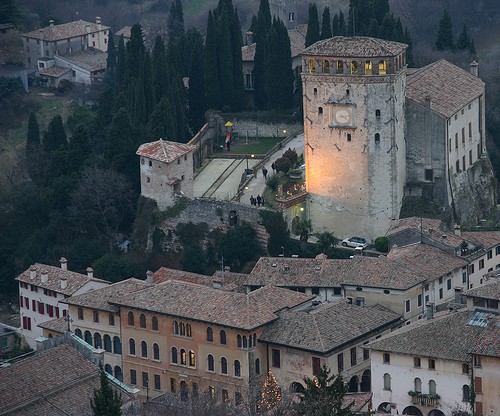
Asolo in Spring: The Hilltop Town the Queen of Cyprus Called Home
Here is the full article:
Asolo in Spring: The Hilltop Town the Queen of Cyprus Called Home
There is a word in Italian that does not exist in English, and it comes from this town.
Asolare. To disport in the open air, to pass time pleasantly with no particular aim, to let the afternoon happen to you rather than happening to it. The poet Pietro Bembo is credited with attaching this meaning to the word in his 1505 dialogues Gli Asolani — three volumes of conversations on the nature of love, set in the court of Caterina Cornaro, Queen of Cyprus, who had been living on this hill in the Treviso province for sixteen years by then, having traded a Mediterranean kingdom for a Venetian hilltop and, by most accounts available to us, made a remarkably good life of it.
The English poet Robert Browning, who visited Asolo briefly at twenty-six and was bewitched by it for the rest of his life, named his final collection of poems Asolando — published on the day of his death in 1889. The explorer and travel writer Freya Stark, who had seen more of the world than almost anyone alive, chose this specific hill to live on and to be buried on. The actress Eleonora Duse, who had dismantled and reassembled the conventions of European theatre from the inside out, came here to recover and to think. Ernest Hemingway stopped here on his routes between Cortina and Venice. Igor Stravinsky came. Henry James came. Giosuè Carducci, who came and then gave the place the nickname it has used ever since, called Asolo la città dei cento orizzonti — the city of a hundred horizons.
All of these people arrived, and all of them, without apparent exception, did not want to leave.
I am Igor Scomparin, a licensed Tour Guide and Tour Leader for the Veneto Region, and Asolo is one of the places in my territory that I most enjoy taking guests to — and one of the places most consistently underestimated by visitors who think of the Treviso province primarily as the hinterland between Venice and the Dolomites. In spring, when the hills turn green and the wisteria blooms on the old stone walls and the views from the Rocca extend across the plain to the Alps still white with the last of the snow, Asolo is — I say this without reservation — one of the most beautiful places in Italy.
Who Was Caterina Cornaro, and Why Does It Matter
The story of how Asolo acquired a queen is one of the more extraordinary episodes in the long history of Venetian political management, and understanding it changes how you walk through the town.
Caterina Cornaro was born in 1454 into one of Venice’s most powerful patrician families. The Cornaro had produced four Doges; they held vast commercial interests across the eastern Mediterranean, including sugar plantations on Cyprus. When James II of Cyprus — known as James the Bastard, which gives you some sense of the diplomatic register of the era — needed a politically credible wife to consolidate his precarious hold on the throne, Venice identified Caterina as the appropriate instrument of their eastern Mediterranean strategy. She was betrothed to James by proxy in Venice in 1468, at the age of fourteen, and formally adopted by the Venetian Republic as a symbolic daughter of Saint Mark — a political fiction that allowed Venice to claim a direct stake in Cyprus through her person.
She sailed for Cyprus in 1472, married James in person, and watched him die the following year, leaving her pregnant and alone in a kingdom surrounded by factions who wanted her gone. She bore a son — James III — who died in August 1474, probably from illness, possibly from something worse. Through sixteen years of widowhood and regency, surrounded by Venetian commissioners who progressively stripped her of real power while maintaining the form of her queenship, Caterina governed Cyprus. She founded hospitals, reformed the administration of justice, created a Monte di Pietà — a public lending institution for the poor — and imported grain from Cyprus during a famine to feed the population. She was, by the evidence available to us, a competent and conscientious ruler operating under conditions of near-total political subordination.
In 1489, Venice finally moved to end the arrangement. Her brother was sent to persuade her to abdicate formally and deed the island to the Republic. The ceremony of surrender was staged with elaborate pomp: Caterina processed through the streets of Famagusta, handed over her kingdom in a public ritual designed to make the whole transaction look voluntary, and sailed back to Venice in a fleet that the Republic turned into a piece of extraordinary civic theater. She was met with honours, given titles she could keep, and awarded the fiefdom of Asolo — a small hill town in the Treviso province — as the compensation for a kingdom.
She took possession of Asolo on October 11, 1489. She was thirty-five years old, in full possession of her intelligence and her political instincts, and she had approximately twenty years ahead of her.
What she built on that hill — the court she established in the castle that still stands at the centre of the town, the network of artists and scholars and musicians and humanists she gathered around her, the cultural life she created in what could have been merely a comfortable exile — was one of the most significant intellectual environments of the Italian Renaissance north of Florence. Pietro Bembo came as a young cousin attending a wedding and stayed, writing the Asolani in dialogue with Caterina’s court. Gentile Bellini painted here. Titian and Giorgione were connected to the circle. The painter Lorenzo Lotto created an altarpiece for the cathedral — his Assumption of the Virgin, which remains there — and it is probable that Giorgione contributed frescoes to Caterina’s villa in the hills.
Gli Asolani was dedicated to Lucrezia Borgia and became a foundational text of Renaissance Neoplatonism and the philosophy of love. Its setting — the conversations in Caterina’s gardens, the music, the debates about sacred and earthly love, the whole atmosphere of cultivated leisure on a Veneto hilltop — gave the humanist tradition a specific geography that it retained for generations. When Bembo described Asolo as a place set at the final ridges of the Alps above the Trevisian plain, he was describing a place where the conditions for a certain kind of thought seemed to prevail — elevated, clear-aired, distant enough from Venice to permit reflection, near enough to remain connected.
Caterina expanded the castle, built a country villa — the barco — in the hills above the town, and governed her small territory with the same practical intelligence she had shown in Cyprus. She never described Asolo as a satisfactory substitute for what she had lost. She never forgot that she was a queen. But she was, by Bembo’s account and the evidence of the court she created, genuinely happy here.
In 1509, the League of Cambrai — the alliance of European powers assembled against Venice — sacked Asolo. Caterina fled to Venice, where she died on July 10, 1510. She is buried in the Church of San Salvador near the Rialto, not far from where she was born.
The Town Itself
Asolo sits on the southwestern spur of the Asolan Hills — the Colli Asolani — at an elevation that gives it the panoramic quality that Carducci’s nickname describes. The town is contained within its medieval walls, which branch off from the twelfth-century fortress, the Rocca, at the town’s highest point. Within those walls, in a space that takes no more than an hour to walk thoroughly, the entire accumulated history of Asolo is legible: Roman, medieval, Venetian, Renaissance, and the nineteenth- and early twentieth-century layer of artists and writers and aristocrats who found here what they had not found elsewhere.
The Piazza Maggiore is the organizing centre of the town, as it has been since the Venetian period. The Fontana Maggiore, a sixteenth-century fountain whose lion of Saint Mark watches over the square in the pose of peace — book open, paw resting on it rather than pressing it closed — still functions. The fountain was, until recently, fed by the same Roman aqueduct that supplied water to ancient Acelum, as Asolo was known when it was a Roman municipium with a forum, a theatre, and baths. Around the piazza: the Cathedral, the Palazzo della Ragione, the Museo Civico, and the lanes that connect them all to the castle and the walls.
The Cathedral — dedicated to Santa Maria Assunta — contains the Lorenzo Lotto altarpiece, which is one of the genuine reasons to come to Asolo even if you have no interest in the historical narrative. Lotto painted it for Asolo and it has remained here, and seeing a major Lotto in its original setting, in the church it was made for, in the light of the hill town it was painted for, is a different experience from seeing Lotto in a museum. The baptismal font in the Chapel of the Santissimo is a gift from Caterina Cornaro to the city — an object she touched, commissioned, paid for — and the plainness of that fact is oddly moving in a cathedral otherwise full of art.
The Museo Civico in the Palazzo della Ragione is worth an hour. The building was the bishop’s palace; it now houses the civic museum’s archaeological section — Roman finds from Acelum, medieval carved fragments, inscriptions — and the rooms dedicated to the three women who made Asolo’s modern reputation internationally: Caterina Cornaro, Eleonora Duse, and Freya Stark. The Duse room is remarkable. Eleonora Duse — the actress whom Stanislavski considered the greatest of her generation, whom Rilke wrote about, whose relationship with D’Annunzio consumed and produced some of the more extraordinary cultural artifacts of the Belle Époque — kept a room at the Albergo al Sole on Via Collegio and died in Pittsburgh in 1924 while on an American tour. She is buried in Asolo, in the Church of Sant’Anna below the town walls, under a simple stone. A plaque by D’Annunzio marks the building where she stayed.
The Castle of Caterina Cornaro stands a short walk from the piazza. The audience hall was converted to a theatre in 1798 — the Teatro Eleonora Duse, named for the actress who performed here — and that particular theatre was purchased in the early twentieth century by the John Ringling Museum of Art, reassembled in Sarasota, Florida, where it still sits. The castle now houses the Asolo Festival, the classical music festival held each summer in the restored theatrical space. What remains open to visitors includes the external structure and the views from the civic tower adjacent to it — views that on a clear spring day extend across the Venetian plain to the Adriatic, or northward to the Dolomites.
The Rocca, the medieval fortress at the summit of the hill above the town, is accessible by a path through olive trees and quiet terraces. The walk is steep enough to be purposeful but not difficult, and the reward at the top — the whole of the Veneto plain laid out below, the hills of Asolo descending in green folds toward the flat agricultural land, the Alps ranged along the northern horizon on a clear day — is one of the finest views in the Treviso province. In spring the olive trees on the path are putting out new growth, the green of the young leaves against the silver of the older ones producing exactly the tonal contrast that makes olive trees beautiful, and the walls of the fortress are lit by morning light from the east at an angle that makes them glow.
The Women of Asolo
Asolo has been, with a consistency that becomes remarkable when you notice it, a town claimed by extraordinary women. The thread runs from Caterina Cornaro in 1489 to Eleonora Duse to Freya Stark to Princess Margaret, who is said to have come here to escape the pressures of London life, and the pattern is not coincidental.
What these women found here — and what I believe they came for, though the historical record is selective about interior motivation — was a combination of beauty, elevation, remoteness from the centres of power that defined and constrained their lives, and a cultural depth that made the remoteness feel like a position rather than an exile. Caterina built a court here because the court was all she had; Duse came here to rest and to think because it was far from the theatrical circuits that consumed her; Freya Stark came here because she had spent forty years traveling through the Islamic world and the Middle East and writing about it, and she wanted somewhere to stop that matched the quality of what she had seen.
Stark is buried in Asolo, in the cemetery of Sant’Anna, a few metres from Duse. Villa Freya — the house she kept in the town, with its garden terraced against the hillside — is open for visits by reservation, and the garden contains the remains of a first-century Roman theatre that was discovered during excavation. This is Asolo’s characteristic mode: the ancient emerging from the domestic, history available underfoot.
Villa Barbaro at Maser: The Essential Detour
Three kilometres from Asolo, on the road toward the valley, stands one of the most significant buildings in Italy. Not in the Veneto. In Italy.
Villa Barbaro at Maser — also known as Villa di Maser — was designed by Andrea Palladio between 1554 and 1560 for the brothers Daniele and Marcantonio Barbaro, and decorated with frescoes by Paolo Veronese in a cycle that represents one of the highest achievements of Venetian Renaissance painting. It has been a UNESCO World Heritage Site since 1996, as part of the designation of the Palladian Villas of the Veneto, and it remains a privately owned working estate — a family still lives here — producing Asolo Prosecco Superiore DOCG from the vineyards on the estate.
Understanding what Palladio was doing at Maser requires a moment of context. His villas were not retreat houses in the Tuscan sense — places where the wealthy went to escape the city for a cultivated idle season. They were working agricultural enterprises built to rationalize the management of large agricultural holdings in the Veneto plain, while simultaneously providing their owners with environments of sufficient dignity and intellectual content to reflect their position in Venetian society. The architecture serves both functions: the barchesse — the wings extending from the central block — were functional farm buildings, housing animals and agricultural equipment; the piano nobile was for receiving, for debating, for being seen as a person of substance and cultivation.
What Veronese did inside the piano nobile — in six rooms of the central block — is something that no description adequately prepares you for. The fresco cycle he painted around 1560 obliterates the distinction between the room you are standing in and the room he invented. Trompe l’oeil architecture opens the walls onto painted landscapes. Painted doors lead into painted rooms. Painted figures — members of the Barbaro family, their children, their dogs, and in one famous instance what appears to be Veronese’s own self-portrait at the end of a receding painted corridor — occupy the space you occupy, looking at you with the mild curiosity of people interrupted in their daily business. A little girl peers around a painted door frame. A hunting dog is caught mid-stride in a painted doorway. The Hall of Olympus on the ceiling gives you the entire Olympian pantheon rendered with the ease and assurance of someone who found mythological allegory as natural a mode of expression as a conversation.
Photography is not permitted inside the villa, which is a policy I understand and endorse. It forces you to look rather than to record, and to take what you have seen out in your memory rather than on your phone, which is the form in which it will matter to you later.
The estate’s wine — Asolo Prosecco Superiore DOCG — is available for tasting at the converted farmhouse on the estate, Casa Diamante, which also offers lunch on a booking basis. Having a glass of the wine produced on the land below the villa you have just stood inside, looking out at the Asolan hills, is a sequence of experience that the Barbaro brothers would recognize as the correct order of things.
The villa sits halfway up the slope of the Asolan Hills, at the precise point where the flat Venetian plain begins to rise. In spring the estate vineyards are putting out their first growth, the garden in front of the villa is beginning its season, and the light on the south facade — the classical portico with its four Ionic columns, the pediment bearing the Barbaro crest — comes from a high spring sun at an angle that makes the stonework luminous. This is not a building to encounter in poor light.
Asolo in Spring: What to Do
Begin in the Piazza Maggiore before the town wakes fully. The Caffè Centrale on the piazza is one of those Italian bars that has been functioning as the social centre of a community for long enough that it has stopped needing to perform that function and simply embodies it. Coffee at the counter, watching the square take shape around you as the morning light reaches the fountain and the shopkeepers open their shutters on the arcaded Via Browning.
Walk the Via Browning — named for the poet who lived in a house at the end of it, Casa La Mura, writing Asolando with a cup of tea — under its cool arcaded porticoes, past the osterie and craft shops and the narrow facades that give onto unexpected gardens. This is the street that Bembo was thinking about when he wrote about asolare: it demands a pace that is neither purposeful nor entirely without direction, the pace of someone who is somewhere beautiful and knows it.
Visit the Cathedral for the Lotto altarpiece. Visit the Museo Civico for the Duse room and the archaeological fragments. Climb to the Rocca in the late morning, when the light is at its best and the spring haze has usually lifted enough to show the mountains to the north. Sit at the top for as long as you need.
For lunch, the osterie along and near Via Browning serve the cooking of the Treviso hills: risotto with herbs and spring vegetables, grilled meats from the local farms, the cheeses of the Asolo territory, the first asparagus of the season if you are here in late March or April. Drink the Asolo Prosecco Superiore DOCG, which is a different appellation from the Prosecco DOC of the plains — higher elevation, cooler temperatures, a slightly fuller body and more pronounced minerality that reflects the hill terroir. It is produced in smaller quantities than the plain Prosecco and deserves its own attention.
Spend the afternoon at Villa Barbaro at Maser. Allow two hours: forty minutes inside, time in the garden, a glass at Casa Diamante. Drive back to Asolo in the early evening and take the aperitivo at the Caffè Centrale or the Enoteca alle Ore on the piazza, with the light going gold on the hills around you and the hundred horizons doing whatever the hundred horizons do at six o’clock in late March, which is to turn colors that have no names.
This day — Asolo in the morning, Maser in the afternoon, aperitivo at dusk — is one of the most satisfying days I know how to construct in the Treviso province, and I have been constructing it for guests for over twenty years. It can be reached from Treviso in forty minutes by car, from Venice in under an hour. It can be combined with a morning in Treviso and an afternoon in the hills, or with a stop at the Prosecco Road vineyards on the return journey. It is the day that, more reliably than any other single itinerary I offer, produces the response I heard from the guests on that first walk by the Sile when we saw the kingfisher: I had no idea this was here.
📩 Asolo and Villa Barbaro at Maser are central to the private day tours I organize in the Treviso hills. Whether you want the full cultural itinerary — Cornaro history, Lotto, Palladio, Veronese, and the Prosecco of the Asolan hills — or a shorter afternoon excursion combined with time in Treviso, get in touch and I will put together a day that fits your visit.
Frequently Asked Questions
How do I get from Treviso to Asolo, and how long does it take?
By car, Asolo is approximately thirty-five to forty minutes from Treviso’s historic centre, following the SP667 toward Castelfranco Veneto and then north through the Asolan Hills. The drive is pleasant in its own right, passing through the vine-covered slopes of the Asolo Prosecco DOCG zone. Asolo is a ZTL — a traffic-restricted zone — in the historic centre, so you park in the car parks on the edge of the town and enter on foot; the walk from the main car park to the Piazza Maggiore is five minutes uphill. There is no practical public transport connection from Treviso to Asolo that allows for a comfortable day visit, so a car — either your own, a rental, or a private driver — is the realistic option for most visitors. I organize private guided excursions from Treviso that include transport, so the logistics are handled from the moment you leave your hotel.
Is Villa Barbaro at Maser worth visiting if I have already seen Palladio’s villas near Vicenza?
Yes, without qualification, and for a specific reason: Maser is the only Palladian villa where Veronese’s fresco decoration survives intact in its original setting. The villas near Vicenza — La Rotonda, Villa Foscari, the others in the UNESCO designation — are architectural masterpieces, but the interior decoration of most of them has been altered, damaged, or stripped over the centuries. At Maser, you walk into rooms that Veronese painted approximately 1560 and that have remained, with the care of the private owners, substantially as he left them. The experience of standing inside a working Veronese fresco cycle — not in a museum, not behind barriers, but in the rooms it was painted for — is not replicated anywhere else in the Veneto at this level of completeness. If you visit only one Palladian villa in the Treviso province, it should be Maser.
What is the Asolo Prosecco Superiore DOCG, and how is it different from Prosecco DOC?
The Asolo Prosecco Superiore DOCG is a separate and distinct appellation from the better-known Prosecco DOC and Conegliano Valdobbiadene Prosecco Superiore DOCG. Asolo Prosecco Superiore is produced in the Asolan Hills — the same hills that define the town’s landscape — at elevations and in soil conditions that differ from the plains production. The result is a wine with slightly more body and minerality than the lighter plains Prosecco, produced in smaller quantities, and with the DOCG designation’s stricter controls over yield and production method. You will find it in the osterie and enoteca of Asolo, and at the estate winery of Villa di Maser, where the estate’s own vineyards produce a version worth tasting alongside the frescoes you have just seen. It is not always easy to find outside the immediate zone, which is one of the arguments for tasting it where it is made rather than looking for it in wine shops in Venice.
Igor Scomparin is a licensed Tour Guide and Tour Leader for the Veneto Region, certified Travel Agency Director, and founder of tourleadertreviso.com. He has been featured in Rick Steves’ travel guides to Italy and Europe since 2008.