Easter in Treviso: The Local Traditions That Make Holy Week in the Veneto Unforgettable
On Palm Sunday morning in Treviso, the Cathedral of San Pietro is full before nine o’clock. I mean genuinely full — standing room along the side aisles, the doors at the back open to the square, people pressed together in the particular way that only happens on the days that actually matter in a city’s annual life. The Bishop’s Mass draws families who have not been inside a church since Christmas. Children carry olive branches the length of their own arms, blessed at the door, which they will bring home and hang behind a door or beside a window until next year, when the old branch comes down for the bonfire of the previous year’s palms. The scent of incense rises through the nave and out through the open doors into Piazza del Duomo, where the pigeons are entirely unimpressed and the bar on the corner is already pulling espresso.
This is the week when Treviso reveals a version of itself that most visitors who come in summer or autumn never see. Holy Week — Settimana Santa — transforms the city’s rhythms in ways that are simultaneously religious, domestic, and gastronomic, and that belong specifically to this territory and its history as a subject city of Venice, shaped by centuries of Venetian rite and tradition. The processions are not Sicily’s, the dramatic elaborations of the south. They are northern Italian: measured, communal, intimate, and deeply felt without being performed. The food is one of the great seasonal tables of Italian cooking — the spring larder of the Marca Trevigiana at its most generous, the eggs and lamb and wild herbs that Lent has denied for forty days arriving all at once in a meal that lasts most of Sunday afternoon.
If you are visiting Treviso for Easter, you are visiting at one of the two or three most rewarding moments of the year. This article tells you what to expect, day by day, and how to experience the week as a local rather than as a spectator.
The Calendar: Holy Week 2026 in Treviso
In 2026, Easter falls on April 5 — a date that places Holy Week squarely in the best of spring, with the Prosecco hills above Valdobbiadene already in bud and the asparagus season in full force across the Piave plain. The key dates are Palm Sunday on March 29, Holy Thursday (Giovedì Santo) on April 2, Good Friday (Venerdì Santo) on April 3, Holy Saturday (Sabato Santo) on April 4, Easter Sunday (Pasqua) on April 5, and Easter Monday (Pasquetta, also called the Monday of the Angel — Lunedì dell’Angelo) on April 6. Both Easter Sunday and Pasquetta are national public holidays. Good Friday is not an official Italian public holiday, but it is treated with particular solemnity in Treviso’s churches and it shapes the day’s character unmistakably.
The Primavera del Prosecco Superiore festival — the spring wine programme across the fifteen municipalities of the Conegliano Valdobbiadene DOCG — is already running by Holy Week, having opened on March 13. Several Mostre del Vino are open across the territory through the Easter weekend, and on Pasquetta the hills above Treviso become one of the most pleasant destinations in the Veneto for a half-day outing. I will return to this.
Palm Sunday: The Olive Branch and the Beginning
La Domenica delle Palme opens Holy Week with the blessing of palm fronds and, more commonly in the Veneto, olive branches. Palm trees are not native to this territory, and the olive branch has served as the liturgical substitute for centuries — a substitution that has given the Venetian tradition its particular character, since the olive branch is local and real in a way that the imported palm frond is not.
At San Pietro Cathedral, the procession of palms begins outside the building and moves into the church for the main Mass of the day. For visitors who want to be part of this rather than observe it from outside, arriving by eight forty-five gives you a place inside the nave. The Cathedral is a complicated building — an accumulation of structures from the fifteenth and sixteenth centuries, expanded and rebuilt multiple times, that contains some of the most important art in the Treviso province: the Cappella Malchiostro with Titian’s 1520 Annunciation altarpiece and Pordenone’s frescoes; the crypt beneath the altar; the Diocesan Museum of Sacred Art accessible from behind. On Palm Sunday, with the nave full and the organ playing and the bishops in vestments at the altar, it acquires a ceremonial weight that the ordinary Tuesday visit does not prepare you for.
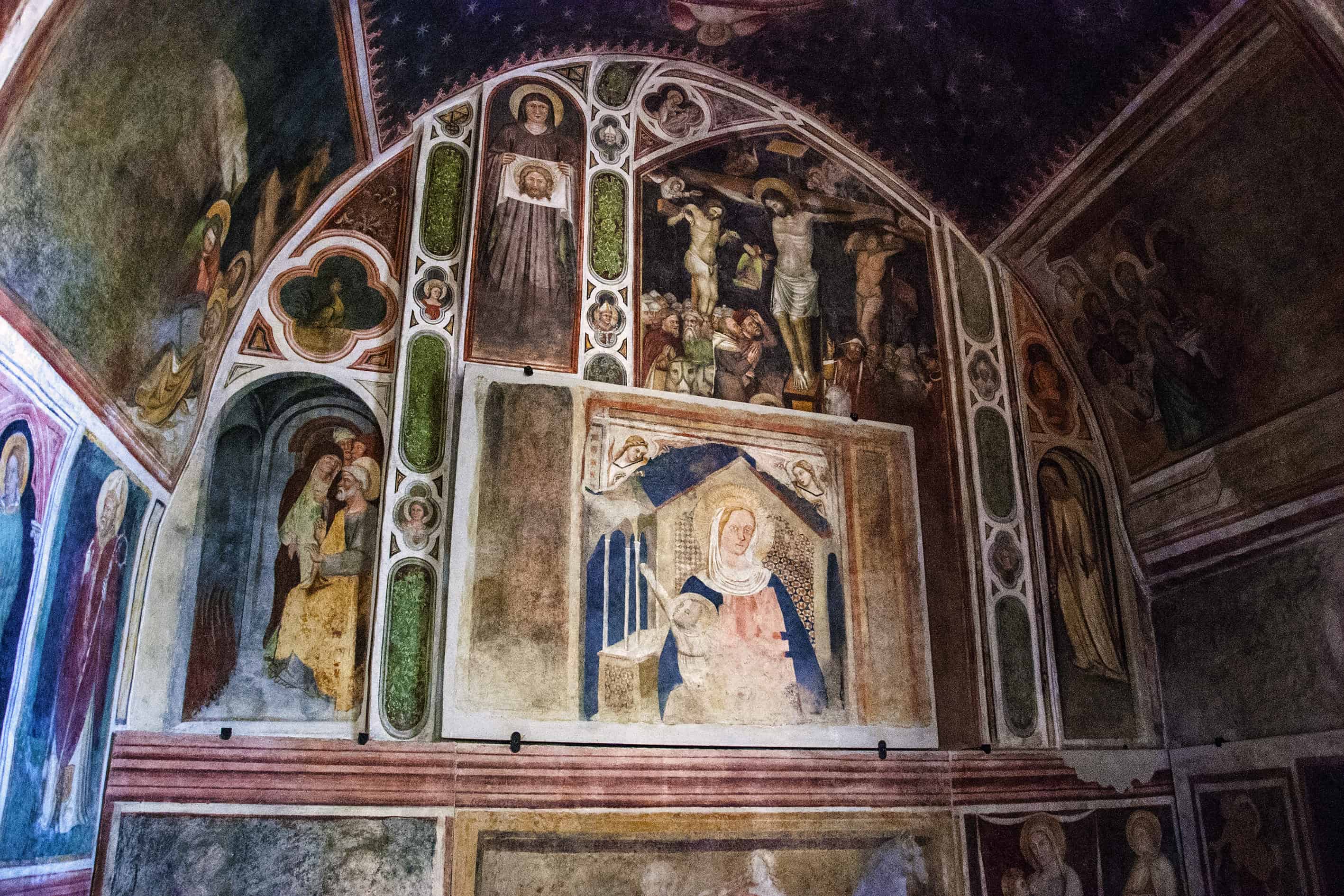
The larger San Nicolò church — the Dominican Gothic building on the Sile, the largest church in Treviso, which contains the remarkable fifteenth-century frescoes by Tomaso da Modena in the adjacent seminary chapter room — holds its own Palm Sunday Mass later in the morning. If the Cathedral crowd feels overwhelming, San Nicolò is the alternative: more space, equally serious liturgy, extraordinary architecture that benefits from the full congregation that Holy Week brings.
After Mass on Palm Sunday, Treviso does what Treviso does: it goes for a walk and then lunch. The canal walks along the Buranelli and past the Pescheria are particularly beautiful in the last days of March, with the plane trees along the rive beginning to leaf out and the water running high from the spring snowmelt. Sunday lunch on Palm Sunday is the first of the great meals of the week, but not yet the main event — that comes six days later.
The Pescheria in Holy Week: The Market at Its Best
One of the things that surprises visitors about Holy Week in Treviso is how visibly the food markets respond to it. The Pescheria — the covered fish market on the island between the Buranelli canal, one of the most beautiful market buildings in northeast Italy — intensifies through the early days of the week in a way that reflects both religious observance and the practical reality of a territory that takes its Friday abstinence from meat seriously.
The Pescheria on Good Friday morning is worth visiting for its own sake as a spectacle of abundance and organization. The tradition of abstaining from meat on Good Friday is observed widely enough in the Veneto that the fish stalls respond: you find stockfish (baccalà) in greater variety and quantity than any other week of the year, along with freshwater fish from the Sile and the Piave — trout, pike, eel — and the shellfish and sea fish that arrive daily from the Adriatic. The vendors know their customers are shopping for the most important meatless meal of the year, and the quality of what they put out reflects this.
The spring produce on the vegetable side of the Pescheria matters equally. By late March and early April in Treviso, the bruscandoli have arrived — the wild hops shoots that grow along the banks of the Sile and the ditches of the plain, harvested from late March through early April and available for a period so brief that if you miss it you wait another year. They look like pale green asparagus tips with smaller leaves and a faintly bitter, herbal character that has no good substitute. The Venetian spring risotto tradition treats bruscandoli as its highest expression: cooked in a light broth with white onion and finished with butter and aged cheese, the result is one of those dishes that makes the concept of seasonal eating feel genuinely urgent rather than fashionable.
The asparagus of the Piave plain — specifically the Asparago Bianco di Cimadolmo IGP grown in the sandy alluvial soils on the left bank of the Piave — is in full season by Holy Week. The white asparagus of this territory is a distinct product from the green asparagus that most American visitors know: fatter, blanched underground to prevent chlorophyll development, with a delicacy of flavor that the aggressive bitterness of some green asparagus lacks. The traditional Trevisan preparation — boiled to precise tenderness, served with hard-boiled egg and olive oil, sometimes with anchovies — is not a recipe you can reconstruct in a New York kitchen from supermarket asparagus. It belongs to this soil, this season, this territory.
Holy Thursday: The Last Supper and the Silence of the Bells
Giovedì Santo commemorates the Last Supper, and the evening Mass of the Lord’s Supper — which typically includes the lavanda dei piedi, the washing of feet, enacted by the celebrant with twelve members of the congregation — is one of the most intimate and affecting liturgies of the entire year. At the Treviso Cathedral, this Mass draws a congregation that is smaller and quieter than Palm Sunday, and proportionally more moved by it. If you attend only one liturgy during your stay in Treviso for Holy Week, I would suggest this one over any other: the scale is right, the ritual has an intimacy that the larger celebrations dilute, and the ceremony of feet-washing — which enacts a gesture of radical service that runs counter to every hierarchy the medieval Church constructed — never loses its capacity to surprise.
After the Mass of the Lord’s Supper, the church bells fall silent. They will not ring again until Holy Saturday at midnight — in Italian tradition, the moment of the Resurrection announcement. This silence of the bells is more noticeable in a city of Treviso’s character than you might expect: the bells of the Cathedral, of San Nicolò, of the smaller parish churches around the medieval rive are part of the texture of daily life in the city, marking the hours and the liturgical moments, and their absence over the next thirty-six hours creates a specific quality of suspension, a hush that the city does not otherwise know.
Some churches cover their statues and crucifixes in purple or black cloth from Holy Thursday through Holy Saturday — a veiling that transforms the interior of the Duomo into a space that feels stripped and vulnerable in a way the ordinary decorative abundance does not.
Good Friday: Venerdì Santo
Good Friday is the most solemn day of the Christian year, and Treviso observes it with a seriousness that is not performative — it is embedded in the daily life of the city in small, specific ways. Many shops and businesses close or operate on reduced hours. The restaurants that remain open tend toward the fish and vegetable menus that Good Friday tradition requires: no meat in any traditional Trevisan household on this day, which in practice means the day’s cooking turns on the bruscandoli, the white asparagus, the Pescheria’s best stockfish, and the first spring vegetables from the market gardens between the Sile and the Piave.
Good Friday is not the occasion for the elaborate public processions that southern Italian cities — Taranto, Trapani, Sorrento — mount with theatrical grandeur and emotional intensity. Northern Italian Holy Week observance is quieter and more interior: the Via Crucis — the Way of the Cross, the fourteen stations marking the Passion of Christ — is marked in the city’s churches with prayer services that proceed through the afternoon and evening, and small processions occur at the parish level, moving between churches, but without the spectacle of southern tradition. The Good Friday evening in Treviso has a quality of quiet that, after the abundance and movement of the previous days, feels appropriate rather than anticlimactic.
The best thing to do on Good Friday evening in Treviso, in my experience, is to walk. The historic center — the streets around Piazza dei Signori, the Loggia dei Cavalieri, the Canale dei Buranelli — acquires a quality of stillness after dark that it does not have on ordinary Friday evenings. The restaurants and bars are open, but more quietly. The streets are not empty but they are unhurried. The canal reflections in the still water, the lights on the stone of the Loggia, the particular silence where the bells would normally be — this is Treviso in one of its most specifically itself moments, available only to those who are here for Holy Week.
Holy Saturday: The Vigil and the Return of the Bells
Sabato Santo is a day of preparation in every sense: the grocers and butchers and bakeries of Treviso are busy, because the families cooking Easter Sunday lunch are buying the lamb, collecting the fugassa they ordered ten days ago from the pasticceria, gathering the wine, choosing the flowers for the table. The Pescheria is less busy than Good Friday — today the meat is coming back tomorrow, and the preparations shift accordingly.
The Easter Vigil — celebrated on Saturday evening, typically beginning around nine or ten at night — is the liturgically most complex and most beautiful service of the entire year: beginning in darkness with the lighting of the Easter fire and the singing of the Exsultet, moving through scripture readings that trace the entire arc of salvation history, culminating in the first Alleluia of the season and the first ringing of the bells after their two-day silence. At the Cathedral, the Easter Vigil draws a congregation that is smaller than Easter Sunday’s but more serious, more theologically informed, more present to what the liturgy is doing. The bells, when they ring at midnight, are audible across the old city, and in a year when Easter falls in early April and the windows are sometimes open to the mild night air, the sound carries across the rive in a way that those who experience it once tend to remember for a long time.
Easter Sunday: The Meal That Defines the Week
Pasqua Sunday in Treviso is organized around a single gravitational center: the family lunch that begins at one in the afternoon and does not conclude until four or five, when the coffee arrives and the grappa is poured and the table has been cleared of everything except the fugassa and the chocolates and the conversation that has been building since the antipasto.
Let me describe the traditional Easter Sunday table in the Marca Trevigiana as it actually exists, which is somewhat different from the generalized Italian Easter lunch that food media tends to describe.
The meal opens with antipasti: sopressa trevigiana — the large, lightly spiced pork salame that is the most distinctly Trevisan of all the local cured meats — alongside boiled eggs, which carry a symbolic weight at Easter that the rest of the year does not assign them. Spring onions, radishes, the first of the season’s tender lettuces, perhaps some white asparagus with olive oil and coarse salt. A glass of Prosecco Superiore DOCG, cold and fragrant, while the table is still being settled.
The primo — the first course — is traditionally one of two things, sometimes both in ambitious households. The spring risotto: made with bruscandoli if the season has been early enough, or with asparagus, or with the first of the spring nettles harvested from the ditch banks before they mature. A good bruscandoli risotto made in the Veneto fashion — the rice toasted in butter and white onion, the broth added ladleful by ladleful, finished off the heat with butter and Grana Padano and allowed to rest for two minutes before serving — is one of the definitive expressions of Italian spring cooking, and one of the reasons I find it genuinely difficult to explain to visitors why Holy Week in Treviso is worth experiencing. You cannot fully understand the season through words. You have to taste the bruscandoli at the peak of their two-week window, in a risotto made by someone who has been making it for forty years.
The tagliatelle in brodo — homemade egg pasta in a clear meat broth — is the older tradition, predating the risotto’s dominance on the modern Trevisan table, and still made in many households as the first course of choice.
The secondo is lamb: agnello arrosto, roasted in the oven with garlic and rosemary and perhaps a splash of white wine in the pan, or sometimes braised slowly with spring vegetables. The Veneto’s preference is for the leg rather than the ribs or shoulder, slow-cooked to the point where the meat gives without resistance. Alongside it: roasted potatoes, the last of the radicchio if the season has held, green vegetables from the garden.
The cheeses arrive after the meat: local Montasio, Piave DOP at various ages, perhaps a soft fresh cheese from one of the farm dairies that operate in the hills above Treviso. Then the desserts: the colomba pasquale — the dove-shaped sweet bread with orange peel and almonds that is the national Easter pastry, produced industrially across Italy but made with care by the best Treviso pasticcerie — and beside it, in any household that takes its local tradition seriously, the fugassa veneta.
The fugassa is the Easter sweet that properly belongs to this territory. The story of its origin is attached to Treviso with unusual consistency across all the sources: legend holds that it was a Trevisan baker who first enriched his bread dough with eggs, butter, and sugar at Easter — the poorest possible enrichment, given the cost of these ingredients — and gave the result to his best customers as a gift. The fugassa veneta is a slow-leavened sweet bread requiring three or four risings over many hours, flavored with citrus zest and sometimes marsala, baked in a round mold or in the cylindrical form of a panettone, and glazed with a mixture of egg, almonds, and granulated sugar that caramelizes in the oven into a brittle, golden crust. It is not a colomba — it is rounder, more citrusy, less structured, more clearly the product of a baker working with what a working household could afford and building toward something beautiful within those constraints. In Treviso’s artisan pasticcerie — Ardizzoni, Nascimben, Tiffany — the fugassa is ordered in advance, collected on Holy Saturday, and presented at the Easter table alongside the colomba as the local version alongside the national one.
The wine on the Easter Sunday table in Treviso is a serious Venetian red: a Raboso del Piave, the indigenous grape of the territory that produces a wine of genuine structure and tannin capable of standing up to roast lamb; or a Merlot or Cabernet from the Piave DOC; or, in households that want to make a statement, a Valpolicella Ripasso or Amarone from the nearby Veronese hills. Prosecco is for the aperitivo. The meal itself belongs to red wine.
After lunch, Treviso’s Easter Sunday afternoon unfolds in the way that Italian festive afternoons do: slowly, with coffee and grappa and the remaining chocolates from the children’s Easter eggs, and then a walk if the weather is good — down the canal streets, past the closed Pescheria, through Piazza dei Signori where the late afternoon light hits the Palazzo dei Trecento at the angle that makes it glow. The Easter weekend weather in Treviso is often the best of the early spring: stable high-pressure systems that bring clear days with the Dolomites visible above the Prosecco hills, temperatures mild enough for a coat but not requiring one.
Pasquetta: The Monday of the Angel and the Gita Fuoriporta
Easter Monday — Pasquetta, the little Easter, the Monday of the Angel — is in many ways the more practically Italian of the two holiday days. Easter Sunday belongs to the family table. Pasquetta belongs to the outside world: the gita fuoriporta, the expedition out of the city, which for Treviso residents means the hills, the river, the countryside, the Prosecco territory in the first full bloom of spring.
The Parco Naturale Regionale del Fiume Sile — the regional park that follows the Sile resurgence river from its springs near Casacorba eastward through Treviso and toward the lagoon — is one of the natural choices for Pasquetta, particularly for families with children. The Sile’s wildlife is at its most active in April: the kingfishers on the overhanging willows, the herons in the shallow water near the reed beds, the first warblers returned from Africa and singing in the canneto with an urgency that reflects the shortness of the breeding season. The path along the Sile bank from Casale sul Sile northward through the park is flat, well-marked, and manageable for children old enough to walk three or four kilometers without complaint.
The Prosecco hills above Treviso — the UNESCO World Heritage territory of the Conegliano Valdobbiadene DOCG — are the other great Pasquetta destination, and in 2026 the timing could hardly be better: the Primavera del Prosecco Superiore festival is in full operation through the Easter weekend, with Mostre del Vino open in the principal communes of the denomination. A Pasquetta that combines a morning walk through the Prosecco vineyards with a visit to the Mostra in Col San Martino or Valdobbiadene, and a lunch at one of the agriturismi that operate in the hills above Follina — this is not a theoretical combination but an extremely practical and well-trodden Trevisan Pasquetta itinerary.
The Pasquetta lunch itself is traditionally the informal cousin of Easter Sunday’s formal meal: a picnic if the weather cooperates, or a table at an agriturismo or simple osteria, with the leftovers from Sunday — the cold lamb, the fugassa, the hard-boiled eggs — supplemented by whatever the outdoor setting suggests. The grigliata — the outdoor grill — is the other Pasquetta tradition: families and groups of friends gathering in gardens or at designated outdoor areas to cook over open flame, with sausages and vegetables and more lamb, in a celebration of spring that is entirely secular and entirely Italian.
The hills between Treviso and Asolo, the Sile park, the Revine Lago natural area north of Vittorio Veneto — all of these attract Treviso families on Pasquetta, and all are worth considering as destinations for a visitor who wants to experience the local tradition of the day rather than spend it in the city center, which is quieter than usual because its residents are elsewhere.
What Makes This Different from Easter in Venice
Venice at Easter is spectacular, and the Via Crucis procession on Good Friday around San Giorgio Maggiore island — torchlit, reflected in the lagoon, surrounded by water on all sides — is among the most visually extraordinary religious events in Italy. I have attended it. I recommend it. And yet there is a reason that my own observation is that Easter in Treviso offers something that Easter in Venice cannot, which is precisely the ordinariness of the participation.
Venice at Easter is Venice performing its own beauty for an international audience, which it does magnificently. Treviso at Easter is a mid-size Italian city living its own calendar, which it does without any awareness that it is being observed. The Palm Sunday Mass at the Cathedral is not organized for visitors; most of the congregation has been attending it since childhood. The bruscandoli risotto at the family table is not prepared for the tourism economy; it is prepared because this is the week when bruscandoli exist and the family expects it. The Pasquetta trip to the Prosecco hills is not a packaged experience; it is what people from Treviso do on the Monday after Easter, as their parents and grandparents did.
This is the most valuable thing that a mid-size Italian city offers a visitor over a major tourist destination: the lived texture of the local calendar, experienced from inside rather than observed from outside. Treviso at Easter is not putting on a show. It is simply being itself, in one of the moments when being itself most fully expresses what it means to live here.
Practical Notes for Visiting Treviso at Easter
Arriving: Treviso is thirty minutes from Venice by train and twenty minutes from Conegliano. Treviso airport is served by the MOM Line 6 bus to the city center, by taxi (approximately €10–15), or by private transfer. Venice Marco Polo airport connects to Treviso by ATVO bus or by train via Venice Santa Lucia.
Accommodation: Book well in advance for Holy Week 2026. The Easter weekend fills Treviso’s hotels — particularly the smaller boutique properties in the historic center — weeks in advance. For the hills above Treviso, the agriturismi around Follina and Cison di Valmarino book out for Pasquetta weekend particularly early.
Restaurants: Many of Treviso’s best restaurants are closed on Easter Sunday, which is a family day observed at home. Those that open for Easter Sunday lunch typically run reservation-only, fixed menus at elevated prices, and they book out entirely in the first two weeks of March. If you plan to eat Easter Sunday lunch in a Treviso restaurant, book immediately. Pasquetta Monday is more flexible: many establishments that close Sunday reopen Monday, and the agriturismi in the hills are specifically oriented toward the Pasquetta meal.
Shops: Most retail shops in central Treviso close on Easter Sunday and operate limited hours on Pasquetta. The Pescheria operates Saturday morning but not Sunday or Monday. The Saturday before Easter is an excellent market morning: the full seasonal abundance of late March asparagus, bruscandoli, spring produce, and Easter preparations visible simultaneously.
Churches: All Treviso churches are open for their liturgical schedule through Holy Week, and all are free to visit. During Masses, entering quietly from the side and remaining near the back is the appropriate protocol for visitors. The Cathedral and San Nicolò are the principal liturgical venues; the smaller parish churches — Sant’Andrea, Santa Maria Maggiore, San Vito — hold their own Holy Week services for their neighborhood communities and have an intimacy that the main churches cannot replicate.
📩 I organize guided Holy Week visits to Treviso combining the city’s churches and art with the local food traditions of Easter — from the Pescheria on Good Friday morning to a spring lunch built around bruscandoli and white asparagus, to a Pasquetta expedition to the Prosecco hills. For couples, families, and small groups who want to experience Easter in the Veneto as a local rather than as a tourist, get in touch.
Frequently Asked Questions
Is Easter in Treviso crowded with tourists?
No — and this is one of the most important things to understand about choosing Treviso over Venice for Holy Week. Venice at Easter receives enormous numbers of visitors drawn by the lagoon setting and the reputation of Italian Easter celebrations, and the city’s famous overtourism pressures are compounded through the holiday weekend. Treviso’s Easter is attended almost entirely by residents of the city and province, with visitors representing a small fraction of the total population in the streets and churches. This has practical consequences: you can walk into Palm Sunday Mass at the Cathedral and find a place, because the crowd is the local congregation, not a queue of international tourists. The Pescheria on Holy Saturday morning is operating as a functioning food market serving local families, not a performance for cameras. The restaurants that open for Easter lunch are booked by local families and regulars, not by tour groups. If you want to be inside Italian Easter rather than photographing it from the outside, Treviso is the right choice. Read more about Treviso versus Venice and why this difference in scale matters.
What is the fugassa veneta and where can I buy one in Treviso?
The fugassa veneta (from the dialect fugassa, meaning focaccia) is the Easter sweet bread that tradition traces to a Trevisan baker — the specific origin story, repeated consistently across all Venetian food sources, holds that an unnamed baker in Treviso enriched his bread dough with the most he could afford: eggs, butter, and sugar in small quantities, producing a soft, sweet loaf that he gave as an Easter gift to his loyal customers. The fugassa requires three or four slow leavening stages, is flavored with citrus zest and sometimes marsala or rum, and is topped with a glaze of egg, almonds, and granulated sugar. It is rounder and more informally shaped than the colomba pasquale, more citrusy in character, and more clearly a product of the local baking tradition. In Treviso, the best versions are produced by artisan pasticcerie that take advance orders: Ardizzoni (known also for its torta zonclada, another local Easter specialty), Nascimben, and Tiffany. All require ordering in advance — typically by the week before Palm Sunday — for collection on Holy Saturday. If you arrive without a reservation, the pasticcerie often retain a small number for walk-in customers, but the best examples go to the regulars who ordered early. The fugassa keeps for several days and travels well, making it an excellent thing to bring home.
How does Easter Monday (Pasquetta) work in the Treviso area, and what should I do with the day?
Pasquetta — literally “little Easter,” officially the Lunedì dell’Angelo — is a national public holiday observed in Italy as the day for outdoor outings, gite fuoriporta (excursions out of the city), and the informal continuation of the Easter celebration with friends rather than family. In the Treviso area, Pasquetta has a specific character that the combination of spring landscape and wine territory makes distinctive. The Prosecco hills above the city are the most popular destination: the Primavera del Prosecco Superiore wine festival has its Mostre del Vino open through the Easter weekend, the vineyards are in early bud, and the weather in the first week of April in the hills north of Treviso is frequently the best of the spring. A Pasquetta that begins with a walk through the vine terraces above Valdobbiadene and includes a visit to a Mostra and lunch at an agriturismo in the hills constitutes one of the most enjoyable single days the Treviso province offers at any point in the year. The Sile river park is the alternative for families with younger children who want flat walking and wildlife observation close to the city. For visitors with a car, the hills around Asolo — thirty minutes from Treviso — host the traditional Sunday antiques market and offer the hilltop town’s spectacular views at the moment when the surrounding landscape is at peak spring beauty. Read more about Asolo as a Pasquetta destination. For those staying in Treviso, the city itself is quieter than usual on Pasquetta — its residents are largely elsewhere — but the restaurants and bars that remain open are unhurried, the canal walks are free of crowds, and the spring light in the historic center has the particular quality that April brings: warm in the direct sun, cool in the shadow of the arcades, the Dolomites sharp on the northern horizon on a clear morning.
Igor Scomparin is a licensed Tour Guide and Tour Leader for the Veneto Region, certified Travel Agency Director, and founder of tourleadertreviso.com. He has been featured in Rick Steves’ travel guides to Italy and Europe since 2008.