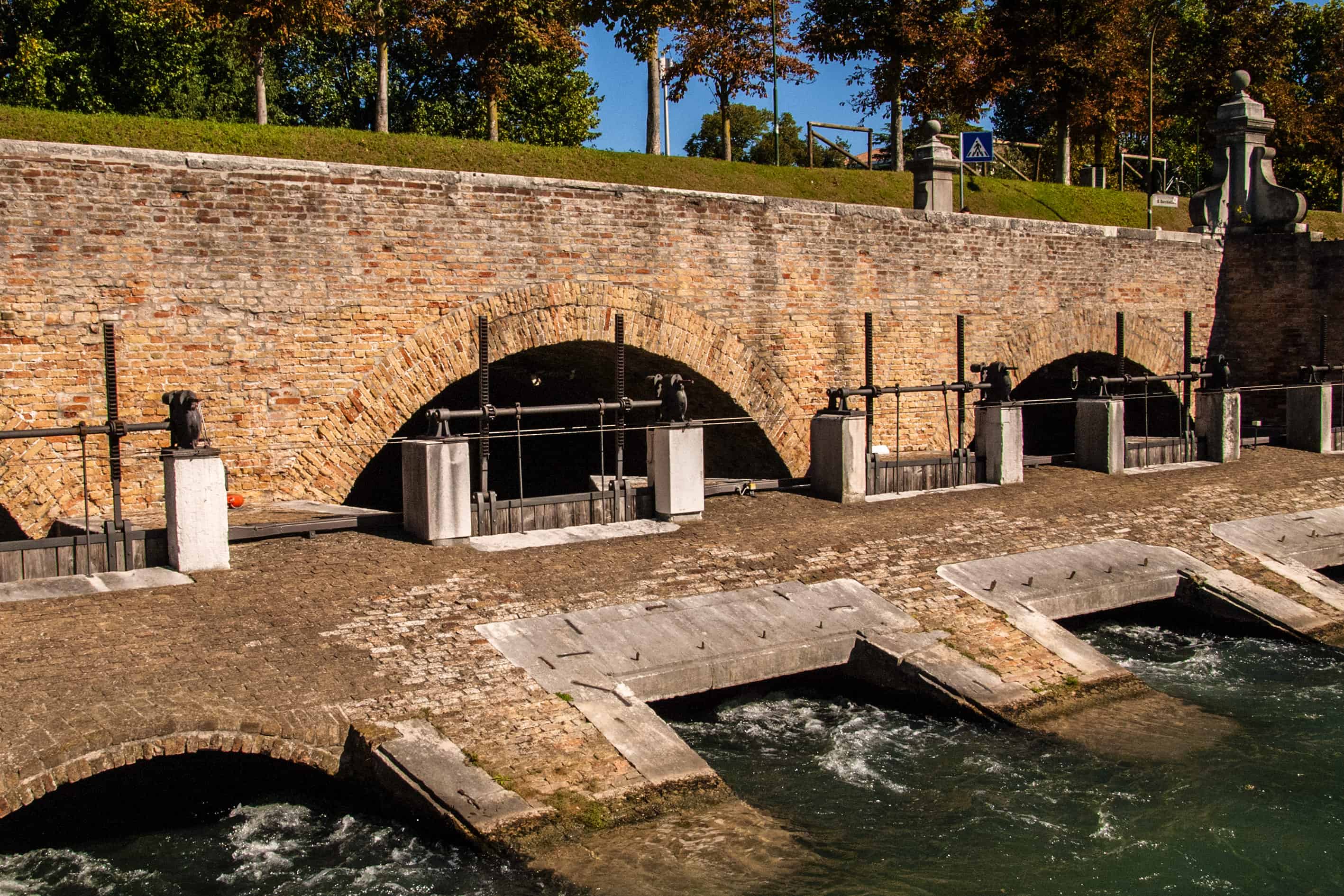
Are Treviso’s City Walls the Most Underrated Monument in Italy?
There is a moment, walking along the southern stretch of Treviso’s city walls in the early morning, when you stop and realize that almost nobody knows this exists.
Not the tourists — they are not here yet, or when they do come, they head straight for the canals and the Pescheria and the Piazza dei Signori. Not even many Italians, outside of the Veneto, could tell you that Treviso possesses one of the best-preserved Renaissance military fortification systems in the entire country.
And yet here it stands. Nearly four kilometres of walls, bastions, moats and gates, built by the greatest military engineers of the Venetian Republic between the late fifteenth and mid-sixteenth century, still almost entirely intact, still encircling the old city in a ring of pale stone and quiet authority.
I am Igor Scomparin. I was born in this region, I have held an official Tour Guide License for the Veneto since 2007, and I have walked these walls hundreds of times. Every time, I find something I had not noticed before. That is what five hundred years of history does — it rewards attention.
Why Did Venice Build Walls Around Treviso?
To understand the walls, you need to understand what Treviso meant to Venice.
From 1339 onwards, Treviso was one of the most strategically important cities in the Venetian Republic’s mainland territories — the Terraferma. It sat at the northern edge of the Venetian plain, controlling the routes that led up into the Dolomites and across to the eastern borders. Whoever held Treviso held the key to the Veneto.
For most of the medieval period, the city was protected by older walls — adequate for an era of infantry and siege engines, but dangerously obsolete by the late fifteenth century. Because by then, everything had changed.
Gunpowder had changed it.
The introduction of artillery into European warfare made the tall, narrow walls of the medieval tradition not just ineffective but actively dangerous — they provided a high target for cannonballs and collapsed in ways that buried defenders rather than protecting them. A completely new approach to military architecture was required, and the Venetian Republic — wealthy, pragmatic, and acutely aware of the threats gathering along its northern and eastern borders — commissioned it.
The result was what military historians call the trace italienne: a system of low, angled bastions, wide earthen ramparts, and deep moats designed not to stop cannonballs but to absorb them, deflect them, and deny the enemy a clean line of fire. It was the most sophisticated military engineering of its age. And Treviso, completed between roughly 1509 and 1517 under the direction of Fra Giocondo and later modified by other Venetian engineers, is one of its finest surviving examples.
What Does the Walk Actually Look Like?
The walls of Treviso form an almost complete circuit around the historic centre — you can walk the full perimeter in about an hour and a half at a leisurely pace, or take a shorter section if you prefer.
The experience changes dramatically depending on which section you choose and what time of day you walk it.
The southern and western stretches, along the Sile and the moat, are the most dramatic. Here the walls rise directly from the water — the river was incorporated into the defensive system as a natural moat, which is why the Sile and its surrounding park feel so integral to the character of the city even today.
(link on “the Sile and its surrounding park”: https://www.tourleadertreviso.com/the-sile-river-trevisos-natural-treasure/)
The bastions — the angular, arrowhead-shaped projections that punctuate the walls at regular intervals — are best appreciated from the outside, where you can see how they were designed to provide overlapping fields of fire, eliminating the blind spots that had made medieval towers so vulnerable. Stand at the tip of one of the major bastions in the late afternoon and look back along the wall: you will immediately understand the geometry. Nothing could approach from this direction without being caught in a crossfire.
The northern stretch, along Viale Fratelli Cairoli and Viale della Repubblica, passes through a more urban landscape — the walls here are partially integrated into the modern city fabric, with gardens and residential streets running alongside them. Less dramatic, perhaps, but with their own quieter beauty.
The Gates: Three Survivors of Five Centuries
The walls are pierced by three main gates, each a monument in its own right.
Porta San Tomaso is the grandest — a triumphal arch in the Venetian Renaissance style, decorated with the lion of Saint Mark and the coat of arms of the Venetian Republic. It was the main ceremonial entrance to the city from the north, and it still functions today as a working gate through which cars and pedestrians pass, apparently without noticing that they are walking through a five-hundred-year-old masterpiece of civic architecture.
Stop and look at it properly. Run your hand along the stone if you can reach it. Think about the fact that this gate has been standing here since roughly 1517, that it watched the armies of the League of Cambrai threaten the city, that Napoleon’s troops marched through it, that it survived two world wars and the entire twentieth century and still stands, solid and unhurried, in a city that has largely forgotten to be impressed by it.
Porta Santi Quaranta — the Gate of the Forty Saints — is the southwestern entrance, more austere than Porta San Tomaso but with its own austere dignity. It takes its name from forty Christian martyrs, and there is a small devotional shrine embedded in the stonework that has been maintained, more or less continuously, since the gate was built.
Porta Altinia, in the northeast, is the most modest of the three, but historically significant as the gate that connected Treviso to the ancient Roman road of the same name — the route that once led all the way to the Adriatic coast.
What the Walls Tell You About Venice
Here is what I find most fascinating about Treviso’s walls, and what I try to convey to every guest I bring here.
These walls were not built to protect Treviso. They were built to protect Venice’s investment in Treviso. The Venetian Republic was, at its heart, a commercial enterprise of extraordinary sophistication — a trading empire that understood, better than almost any other power of its era, that security was the precondition for prosperity.
The military engineers who designed these walls were the same intellectual circle that produced some of the greatest art and architecture of the Italian Renaissance. Fra Giocondo, who oversaw much of the early work on Treviso’s fortifications, was also an architect, an antiquarian, and a friend of Leonardo da Vinci. The walls were not just functional objects — they were expressions of a particular idea about order, geometry, and the relationship between a city and its landscape.
You can see this if you look at the way the bastions are positioned. They are not placed arbitrarily — each one commands a specific view, controls a specific approach, fits into a system that was calculated with mathematical precision. Walking the walls is, in a sense, walking through a piece of applied Renaissance mathematics. Which is either deeply nerdy or deeply beautiful, depending on your point of view. I find it both.
This same tradition of Venetian architectural thinking — that beauty and function are not opposites but expressions of the same underlying intelligence — runs through everything the Republic built in this region. You see it in the Palladian villas of the Treviso countryside, where the same principles of geometry and proportion that govern the bastions reappear in the colonnades and pediments of the country houses.
(link on “Palladian villas of the Treviso countryside”: https://www.tourleadertreviso.com/the-hidden-villas-of-treviso-province-palladios-lesser-known-works/)
You see it in the churches, in the frescoes, in the layout of the streets. Treviso is, in this sense, a remarkably coherent city — one where five centuries of Venetian governance left a surprisingly consistent aesthetic imprint.
The Walls and the City: How They Shape Daily Life
One of the things that strikes every visitor who actually pays attention to the walls is how naturally they are integrated into the daily life of modern Treviso.
The moat has become a park. The ramparts are used for cycling and walking. Children play football in the shadow of the bastions. Couples walk along the outer edge of the walls in the evening, the Sile glittering below them, the stones of the fortifications warm in the last of the afternoon light.
This is not accidental. The walls were never demolished — unlike in many Italian cities, where nineteenth-century urban expansion saw the old fortifications torn down to make way for broad modern avenues — and their survival means that Treviso retains a physical memory of its own shape. The old city is still legible as a city. You can still feel, standing inside the walls, that you are somewhere with a boundary, a definition, a sense of inside and outside that most modern urban environments have entirely lost.
The best time to walk the walls is early morning, when the light is low and the city is quiet and the canal district feels like something from another century.
(link on “canal district”: https://www.tourleadertreviso.com/a-locals-guide-to-trevisos-canal-walks-the-routes-tourists-miss/)
The second best time is the evening, when the stone holds the warmth of the day and the bats — and there are always bats, looping along the ramparts at dusk — emerge from the crevices in the ancient masonry and begin their own patrol of the perimeter.
Connecting the Walls to the Rest of Treviso
The walls are best experienced as part of a broader walk through the historic centre rather than as a standalone attraction.
I typically begin a guided walk of the old city at Porta San Tomaso, then move inward along the medieval street pattern toward the Piazza dei Signori and the Loggia dei Cavalieri — one of Treviso’s most beautiful and least celebrated monuments.
(link on “Loggia dei Cavalieri”: https://www.tourleadertreviso.com/trevisos-best-kept-secret-the-church-of-san-nicolo/)
From there, a short walk brings you to the Pescheria and the canal system, then south along the water to the base of the walls. Walking outward through Porta Santi Quaranta, you get the full external view of the fortifications from the south — the moat, the rampart, the bastion — before looping back east along the outer perimeter toward the Sile.
The whole circuit, with stops, takes about three hours at a relaxed pace. It is, in my opinion, the single most rewarding walk you can do in Treviso — and almost nobody does it.
(link on “Pescheria”: https://www.tourleadertreviso.com/trevisos-fish-market-a-morning-ritual-since-1856/)
A Note on What You Will Not Find Here
There is no entrance fee to walk Treviso’s walls. There is no ticket booth, no audio guide, no gift shop. There is no crowd. There are no tour buses parked outside.
There is just the stone, the water, the geometry, and the long, quiet evidence of five centuries of human ambition and intelligence.
That is, I would argue, exactly as it should be. Some of the greatest things in Italy do not announce themselves. They simply wait for the people who are paying enough attention to find them.
If you would like to walk the walls with someone who has spent years learning to read them — who can show you where to stand to understand the geometry, which gate to approach from which angle, and which bar near Porta San Tomaso serves the best spritz in that corner of the city — I would be glad to take you.
(link on “spritz”: https://www.tourleadertreviso.com/where-to-find-the-best-spritz-in-treviso-according-to-a-local/)
📩 Get in touch to arrange a private walking tour of Treviso’s historic centre and city walls.
Frequently Asked Questions
Can you walk the full circuit of Treviso’s city walls?
Yes, and I strongly recommend it. The walls form an almost complete ring around the historic centre — roughly four kilometres in total — and the full circuit can be walked in about ninety minutes at a comfortable pace. The most dramatic sections are along the southern and western edges, where the walls rise directly from the Sile River and the original moat. The path along the outer perimeter is mostly flat, well-maintained, and accessible throughout the year. Early morning is the best time to go — the light is extraordinary and you will have the path almost entirely to yourself.
Do you need to pay to visit Treviso’s city walls?
No. The walls are entirely free and open to the public at all times. There is no ticket, no entrance gate, no guided tour required. You can simply walk out of the historic centre through any of the three surviving gates — Porta San Tomaso, Porta Santi Quaranta, or Porta Altinia — and begin exploring the outer perimeter immediately. This makes the walls one of the most remarkable free experiences in northeastern Italy, and one of the most underused.
How do Treviso’s walls compare to other Italian fortifications?
Treviso’s walls belong to a specific tradition of Renaissance military engineering — the trace italienne — that also produced famous fortifications in Lucca, Palmanova, and Bergamo. What makes Treviso distinctive is the exceptional state of preservation combined with the almost complete absence of tourist infrastructure around them. In Lucca, for example, the walls are extremely well known and heavily visited. In Treviso, you can walk the same quality of Renaissance military architecture in near-total solitude, integrated into a living city that has simply never made a fuss about what it has. For anyone with an interest in military history, architecture, or the Venetian Republic, Treviso’s walls deserve to be on the same list as the more famous examples — and arguably offer a more genuine experience precisely because they are not.
Igor Scomparin is a licensed Tour Guide and Tour Leader for the Veneto Region, certified Travel Agency Director, and founder of tourleadertreviso.com. He has been featured in Rick Steves’ travel guides to Italy and Europe since 2008.