Casa da Noal: Treviso’s Best-Kept Gothic Gem (That Most Tourists Walk Right Past)
I have everything I need. Here is the full article:
Casa da Noal: Treviso’s Best-Kept Gothic Gem (That Most Tourists Walk Right Past)
There is a palazzo on Via Canova that most visitors to Treviso pass without stopping.
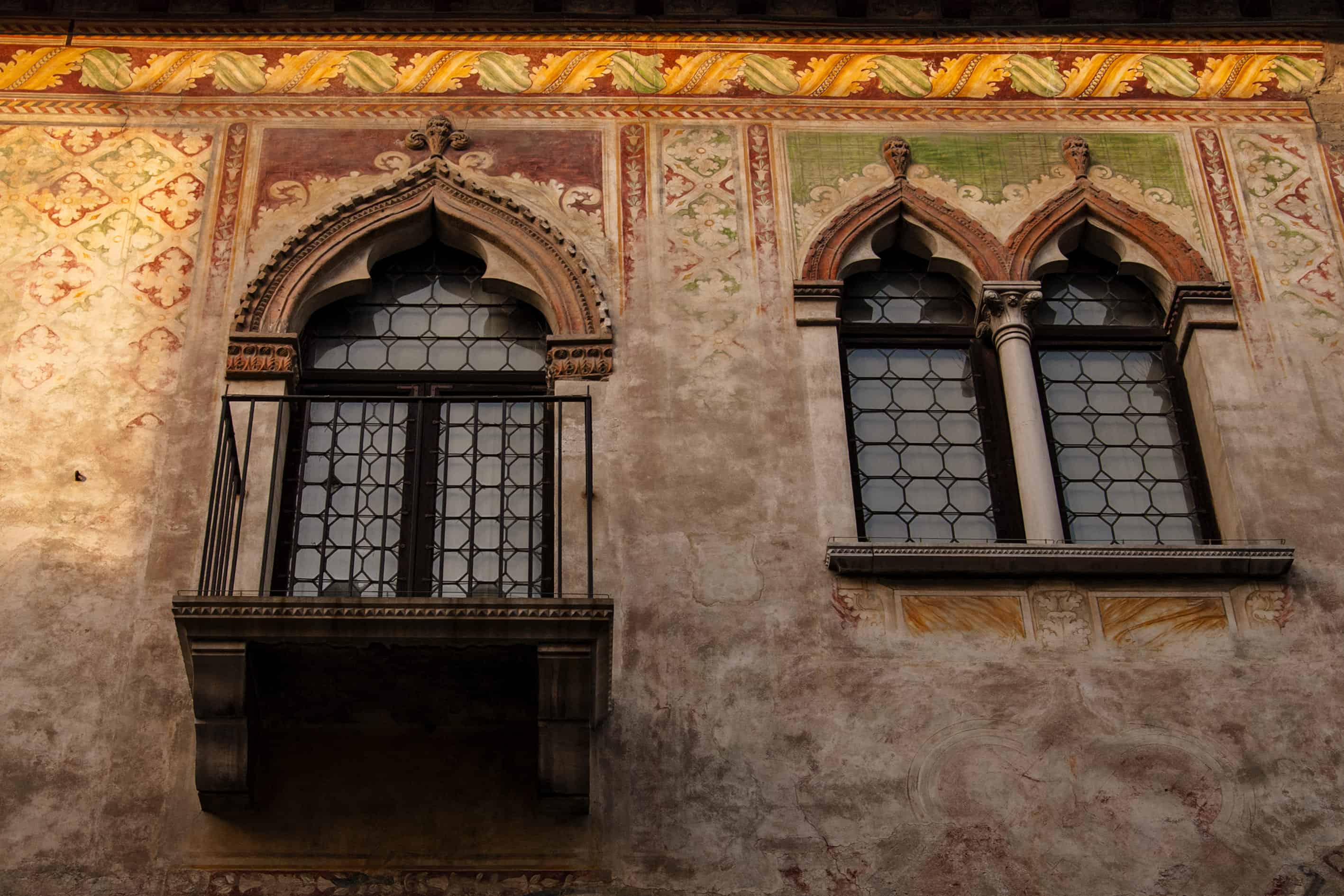
I have watched this happen hundreds of times. A group comes out of the Duomo, turns left toward the Museo Bailo, and moves along Via Canova at the pace of people who have a list of things to see and are working through it efficiently. They pass a facade of five pointed Gothic arches in pale Istrian stone, a piano nobile with elegant twin-arched windows set in brick, traces of fresco in red and green still visible on the plaster — and they keep walking. The building is not signposted in the way that the famous monuments are signposted. There is no queue outside it. Nobody is taking a photograph of it. And so it goes unnoticed, which is, from a certain perspective, one of its finest qualities.
The building is Ca’ da Noal — or Casa da Noal, the names are used interchangeably — and it is, along with its two adjacent medieval neighbours Casa Robegan and Casa Karwath, one of the most complete and architecturally significant examples of late Venetian Gothic civic building in the entire Treviso province. It is not, in any conventional sense, hidden. It sits on one of the city’s main streets, three minutes from the Piazza dei Signori, open to visitors as part of the Musei Civici network. It has simply never been adequately explained to people who are arriving in Treviso for the first time and are trying to understand what they are looking at.
I am Igor Scomparin. I am a licensed Tour Guide for the Veneto Region, and I have been bringing guests through Treviso for nearly twenty years. Ca’ da Noal appears in every serious tour I lead of this city, and explaining it properly takes longer than most guides allow, because the building’s interest lies not in any single famous artwork or obvious spectacle but in an accumulation of things that reward attention: the architectural detail of the facade, the layered history of who built it and what it became, the story of its destruction and reconstruction, and the unexpected presence of Carlo Scarpa — one of the greatest architects of the twentieth century — in its interior spaces. This article attempts to give you everything you need to engage with Casa da Noal seriously, including what it looks like, what it contains, how it came to be what it is now, and why it deserves more time than most visitors give it.
The Building and What It Looks Like
Ca’ da Noal was built in the first half of the fifteenth century in late Venetian Gothic style, incorporating earlier Romanesque elements and receiving sixteenth-century additions — which means the building you see today is a palimpsest, multiple construction phases legible simultaneously if you know where to look, unified by the dominant Gothic character of the main facade.
The facade on Via Canova is organised around five large pointed arches at ground level — archi a sesto acuto, the characteristic sharp-pointed arch of Venetian Gothic architecture — resting on pilasters, forming an open portico with a coffered ceiling of wooden beams and panels. Under this portico, the eye is drawn to the main entrance: a rectangular doorway in Istrian stone topped by a trilobed pointed arch with an open crown finial, the kind of refined stonework that in Venice would mark a building of the merchant nobility and here in Treviso serves the same social signalling function. Five small square windows flank this entrance at ground level.
The piano nobile — the primary residential floor, above — is built in plastered brick and is where the building’s Gothic ornament concentrates. Elegant bifore — twin windows — alternate with single windows with small balconies, all framed with trilobed Gothic arches in exposed brick. The combination of pale plaster surface with the darker brick tracery of the window surrounds creates the characteristic chromatic rhythm of Venetian Gothic that you see on the Grand Canal palaces in Venice, transposed here to a Trevisan merchant’s house at a slightly less magnificent but no less serious scale.
On the side facade, on Via Fra’ Giocondo, the exterior brickwork is left exposed, and single Gothic windows with small balconies continue the decorative programme. What survives of the original fresco decoration — visible as traces on the main facade and the rear wall where the courtyard stair meets the building’s central body — shows a pattern of red and green flowers on white ground, with festoons and false marble dados below the windows. In the main hall of the piano nobile, a frieze of fifteenth-century frescoes with festoons and putti survives in better condition, giving a clearer picture of how the entire building was once decorated throughout.
The internal courtyard is where Ca’ da Noal reveals what the street facade only suggests: an L-shaped staircase with a balustrade of cylindrical column balusters, supported at its upper reach by heavy corbels and a column with capital, leading to doorways and windows at successive levels — a trifora at the top of the second flight — that mirror the forms of the street facade. The courtyard is private in the way that Trevisan Gothic courtyards are private: visible from within, enclosed, organized as a domestic sequence of spaces leading upward. A garden extends behind the complex, one of the more unexpected and pleasant spaces in this part of the historic centre.
The Family, the Name, and the Building’s Original Life
The name Ca’ da Noal records a migration. The building was constructed by the Campagnari family — in some documents Campagnaro — who came to Treviso from Noale, a small town southwest of the city in the Venetian plain, and who adopted the name of their place of origin as their city surname. This practice was common in the Veneto — families arriving in a new city often identified themselves by where they had come from, and the name stuck across generations. The da Noal designation therefore does not refer to a family called Noal but to the family from Noale, which is a meaningful distinction for understanding how Treviso’s medieval social geography worked: as a city that absorbed families from across the province and gave them status proportional to the quality of the buildings they constructed.
Among the family’s documented members is Alvise Campagnari, a jurist and benefactor of the Benedictine convent at Noale, who lived in the sixteenth century — by which point the sixteenth-century additions to the original Gothic structure had already been made, and the building had been in continuous aristocratic and mercantile use for several generations. What the building looked like in its original fifteenth-century form, how much of the surviving Gothic is original versus recovered in later restorations, is a question the building’s history makes complicated, and I will address that complexity directly.
What the Building Became: The Museum History
Ca’ da Noal and its two neighbors were acquired by the City of Treviso in 1935, at which point they began a new life as civic cultural institutions rather than private residences. The first significant intervention was the restoration by Melchiori and Mario Botter in 1938, which recovered and in some cases reconstructed the Gothic character of the facades — a restoration in stile gotico, as the documents describe it, meaning that what you see today is a twentieth-century interpretation of medieval form rather than pure medieval fabric. This distinction matters, and I raise it not to diminish the building but because understanding what restoration has done to Italian medieval architecture, and what it has not been able to do, is part of understanding why Casa da Noal looks the way it does and why the question of authenticity in its case is more interesting than a simple yes or no.
In 1938 the complex became the home of the Museo della Casa Trevigiana — the Museum of the Trevisan House — which was moved here from its previous location in Borgo Cavour. The concept was the recreation of a historical Trevisan domestic interior across the floors of the building: a kitchen on the ground floor, drawing rooms, a dining room, and a music room on the piano nobile, furnished with period furniture, paintings, and objects to give visitors an experience of bourgeois Trevisan domestic life across the centuries. It was an ambitious and interesting programme for 1938, and it established the building’s identity as a place concerned with the material culture of the city rather than with single masterworks.
Then came the bombing.
On April 7, 1944, Allied aircraft bombed Treviso in one of the most destructive raids on any Italian city during the Second World War. The historical centre was severely damaged — San Nicolò was hit, the Loggia dei Cavalieri was damaged, entire districts were reduced to rubble. Ca’ da Noal was half destroyed, and the collections of furniture, objects, and decorative arts it housed were partially lost. The reconstruction that followed, again by Mario Botter, rebuilt what the bombs had taken away, which means that the building you visit today is partly fifteenth century, partly 1938, and partly post-1944 — a layered object that is honest about its history only if you know to ask the question.
From the 1970s onward, the interior of Ca’ da Noal was reorganised for a new purpose: temporary exhibitions, primarily of twentieth-century art and applied arts, with exhibition spaces designed by Carlo Scarpa. This is the detail of the building’s recent history that stops architecture students and Scarpa devotees in their tracks, because Carlo Scarpa — born in Venice in 1906, the designer of the Castelvecchio museum renovation in Verona, the Fondazione Querini Stampalia in Venice, the Gipsoteca Canoviana extension in Possagno, and the Brion Tomb at San Vito di Altivole just outside Treviso — is one of the most consequential architects of the twentieth century, a figure who transformed how museums display objects and how modern interventions can inhabit historic buildings. His work at Ca’ da Noal is less celebrated than the Castelvecchio or the Querini Stampalia, but his involvement here places the building in a lineage of Scarpa’s engagement with exactly the question that Ca’ da Noal poses most urgently: what does it mean to insert the contemporary into the medieval, and how do you make that conversation visible rather than concealing it?
The Gino Rossi retrospective held here in 1974 — in Scarpa’s exhibition spaces, in this restored-and-reconstructed Gothic building — is remembered as one of the significant exhibitions in Treviso’s postwar cultural history. Rossi, a Trevisan painter of genius who spent part of his life in a psychiatric institution and whose work was rediscovered in the decades after his death, was given a retrospective in what was then the most technically sophisticated exhibition space in the city. The pairing of Rossi’s troubled, vibrant painting with Scarpa’s austere and precise interior design was, by all accounts, remarkable.
The Lapidario and What It Contains
The permanent collection of Casa da Noal is the lapidario of the Musei Civici di Treviso: the collection of stone inscriptions, architectural fragments, Roman remains, medieval carvings, and sculptural pieces that were gathered over the nineteenth and twentieth centuries as the city’s historic fabric was excavated, demolished, or cleared during urban works.
A lapidario is not the most immediately accessible type of museum collection, and I will be direct with you: if you arrive at Casa da Noal expecting a gallery of paintings or a display of decorative arts, you will be initially disoriented. The lapidario is a collection of fragments — Roman funerary inscriptions in Latin, medieval capitals, architectural elements from buildings that no longer exist, carved reliefs that were once embedded in façades or church interiors but have been detached and preserved here. The individual objects require patience and some epigraphic or architectural knowledge to engage with fully, which is one reason the collection is not heavily visited by general tourists.
What the lapidario offers that a conventional art museum does not is a different kind of encounter with time. The Roman inscriptions in this collection record the names and circumstances of Treviso’s Roman-period population — the city was the Roman Tarvisium, an important municipium on the road network of northeast Italy, and its Roman layer is more substantial than most visitors know. The medieval fragments record the formal vocabulary of twelfth and thirteenth-century Trevisan stone carving, which was a distinct regional tradition with its own character. Taken as a whole, the lapidario is an archaeological argument about the depth of Treviso’s urban continuity — the claim that this city has been a sophisticated place since at least the Roman period, and that the evidence for this claim survives in stone even when the buildings that once contained the stones do not.
This is not the argument that most tourism makes about Treviso. Most tourism about Treviso makes an argument about radicchio and Prosecco, about canals and frescoes, about medieval charm and aperitivo culture. The lapidario makes a different and older argument, and engaging with it changes how the rest of the city reads. After an hour in the stone fragment collection, the Roman street grid that underlies Treviso’s modern layout becomes legible in a way it was not before. The medieval civic buildings of the Piazza dei Signori — the Palazzo dei Trecento, the Palazzo del Podestà — become part of a longer sequence rather than isolated medieval monuments.
The Complex Today: Casa Robegan and the Garden
Ca’ da Noal is part of a complex of three adjacent buildings, and the other two are worth noting separately.
Casa Robegan, the central building of the complex, became in 2020 the subject of a new cultural agreement between the City of Treviso, the Ca’ Foscari University of Venice, and TRA — Treviso Ricerca Arte — which established it as an experimental museum laboratory, a publicly-and-privately managed space explicitly dedicated to research at the intersection of contemporary art and the productive economy of the region. This is an interesting and ambitious institutional model: using a historic building that was originally conceived as a museum of applied arts as a space where artists engage with the industrial and commercial culture of the Veneto, and where the productive sector benefits from the innovative perspective that art can bring. Whether this model succeeds in practice depends on the quality of the programming it generates, which varies — but the aspiration is coherent and worth attending to.
Casa Karwath, the third building, contains additional exhibition spaces that support the temporary programme.
The garden behind the complex is one of those Treviso spaces that appears on no itinerary and that visitors who discover it by accident remember with particular pleasure. It is not a formal garden — it does not have the architectural grandeur of some Venetian garden spaces — but it is a genuine green enclosure in the heart of the historic centre, shaded, quiet, accessible when the museum is open, and completely unvisited at most times. On a warm spring afternoon, with asparagus season beginning in the surrounding countryside and the light coming over the roofline at an angle that catches the brick of the Gothic windows, the garden behind Casa da Noal is one of the places in Treviso I most reliably feel the city’s full weight — its age, its particularity, its stubborn refusal to arrange itself for the comfort of people who have not spent time learning how to read it.
How to Visit: Practical Information
Casa da Noal is part of the Musei Civici di Treviso network, which means that a combined ticket covers it and the other civic museums including the Museo Bailo and the Santa Caterina complex. The building is on Via Canova, between the Duomo and the Museo Bailo — it is almost impossible to visit one without passing the other, and the three buildings together constitute the cultural itinerary of the northern part of the historic centre. The FAI — Fondo per l’Ambiente Italiano, the Italian national trust — offers a 40% entry discount to members.
Opening hours are subject to change depending on whether a temporary exhibition is in place; the Musei Civici website carries current information. When no temporary exhibition is running, the permanent lapidario collection is accessible. When a temporary exhibition is installed, the building’s character changes substantially — the Scarpa-designed exhibition spaces fill with contemporary or twentieth-century work, and the medieval Gothic shell becomes a backdrop for whatever the curators have chosen to present. Both states are worth experiencing, for different reasons.
The temporary exhibition programme at Casa Robegan has historically been oriented toward Venetian painters and sculptors of regional significance, as well as applied arts and design. The quality varies, as it does with any temporary programme. My advice is to check what is currently showing before you go, not because the building is not worth visiting in any circumstance but because knowing what you are walking into allows you to calibrate your attention appropriately. Go for the building. Go for the garden. What you find inside is a bonus.
If you have any interest in Carlo Scarpa and his work in the Veneto — and if you are visiting this region and have not heard of him, I would urge you to remedy this — the visit to Casa da Noal pairs naturally with the Tomba Brion at San Vito di Altivole, less than thirty minutes from Treviso by car, which is Scarpa’s masterwork and one of the most extraordinary architectural experiences in northeast Italy. The Gipsoteca Canoviana at Possagno, where Scarpa added an extension to the neoclassical plaster-cast museum in 1957, is forty minutes away. These three sites — Casa da Noal in Treviso, the Brion Tomb outside Treviso, and the Gipsoteca at Possagno — constitute a Scarpa circuit that any architecturally serious visitor to this province should plan around. I organize private guided days that combine all three.
Why This Building Matters in the Larger Picture of Treviso
Let me say directly what I believe about Ca’ da Noal, because it is the argument I make to guests who have spent their morning at San Nicolò and their early afternoon at the Piazza dei Signori and are deciding how to use the remaining hours before dinner.
Ca’ da Noal is the building in Treviso that makes the most honest argument about what this city is and has been. San Nicolò is magnificent, and the Tomaso da Modena frescoes in its chapter house are among the great treasures of fourteenth-century Italian painting. The Piazza dei Signori is beautiful, and the Palazzo dei Trecento tells the story of the medieval commune with architectural clarity. The canals are what they are — a working hydrological system that became one of the most distinctive urban environments in northern Italy.
But Ca’ da Noal does something those monuments do not do. It shows you Treviso in its complexity: a late medieval merchant’s house built by a family who named themselves after where they came from, restored and partly invented in 1938 in the spirit of a particular cultural politics, bombed in 1944, rebuilt again, given to one of the century’s greatest architects to redesign for exhibitions, and now functioning as a civic museum that holds the accumulated stone fragments of two thousand years of urban life. That sequence — construction, identity, destruction, reconstruction, repurposing — is the sequence of almost every significant building in every Italian city that has survived to the present. Ca’ da Noal just makes it visible rather than concealing it behind a single authoritative narrative about authenticity.
Understanding this building changes how you see the rest of Treviso. Which is why I spend time on it with every serious visitor.
📩 I include Ca’ da Noal in every full-day tour of Treviso’s historic centre, because the building rewards explanation and demands context that a solo visit cannot fully supply. If you want to understand Treviso in depth — its Gothic architecture, its civic history, its relationship with Carlo Scarpa and the wider Veneto cultural tradition — get in touch to arrange a private guided tour.
Frequently Asked Questions
Is Casa da Noal worth visiting if I only have one day in Treviso?
Yes, but with a calibration. If you have a single full day in Treviso, your itinerary should be built around San Nicolò, the Pescheria, the Piazza dei Signori, and a canal walk — these are the experiences that give you the essential character of the city. Within that day, Ca’ da Noal is directly on the route between the Duomo and the Museo Bailo, and stopping to look at the facade carefully costs you five minutes and nothing else. If a temporary exhibition is currently showing that interests you, add twenty to thirty minutes for the interior. If you are specifically interested in Gothic civic architecture, in Carlo Scarpa, or in the archaeological history of Treviso, the lapidario and the Scarpa-designed exhibition spaces justify a more extended visit of forty-five minutes to an hour. The garden behind the complex, which almost no visitor discovers, is worth ten minutes of anyone’s time regardless.
What is the connection between Casa da Noal and Carlo Scarpa, and why does it matter?
From the 1970s onward, Carlo Scarpa designed the exhibition infrastructure — display cases, lighting systems, spatial organisation — for the temporary exhibition spaces inside Casa da Noal. Scarpa, who was born in Venice in 1906 and spent his career working almost entirely in the Veneto, is considered one of the most important architects of the twentieth century, particularly for his ability to insert contemporary design into historic buildings in ways that make the dialogue between old and new explicit rather than concealing it. His best-known works in the province of Treviso include the Brion Tomb at San Vito di Altivole — his acknowledged masterwork, and the place where he himself is buried — and the extension of the Gipsoteca Canoviana at Possagno. His presence in Casa da Noal is less frequently discussed than these major projects, but it is significant: it places this Gothic merchant’s house within the intellectual lineage of Scarpa’s engagement with medieval Venetian architecture and with the question of how twentieth-century museum design should inhabit historic spaces. For visitors with any interest in Scarpa, Casa da Noal is a natural starting point for a province-wide Scarpa itinerary.
How does Casa da Noal relate to the other medieval buildings in Treviso’s historic centre?
Treviso has three medieval buildings that together constitute a serious argument about the city’s Gothic civic culture: the Loggia dei Cavalieri, built in 1276-77 as a noble gathering space and literary salon; the Palazzo dei Trecento in the Piazza dei Signori, the council chamber of the medieval commune; and Ca’ da Noal, the finest surviving example of Gothic merchant domestic architecture in the city. The Loggia dei Cavalieri is in the Piazza dei Signori, accessible and free; the Palazzo dei Trecento is the large hall facing it; Ca’ da Noal is five minutes north on Via Canova. Taken together, these three buildings map the social geography of medieval Treviso: civic government in the Palazzo dei Trecento, aristocratic cultural life in the Loggia, mercantile domestic ambition in Ca’ da Noal. Reading them as a set, rather than as isolated monuments, gives you a more complete picture of what kind of city Treviso was in the thirteenth and fourteenth centuries — a city of considerable sophistication, political complexity, and cultural ambition that deserves to be understood on its own terms rather than as a satellite of Venice.
Igor Scomparin is a licensed Tour Guide and Tour Leader for the Veneto Region, certified Travel Agency Director, and founder of tourleadertreviso.com. He has been featured in Rick Steves’ travel guides to Italy and Europe since 2008.