Cycling the Prosecco Hills in Spring: A Route Between UNESCO Vineyards and Ancient Villages
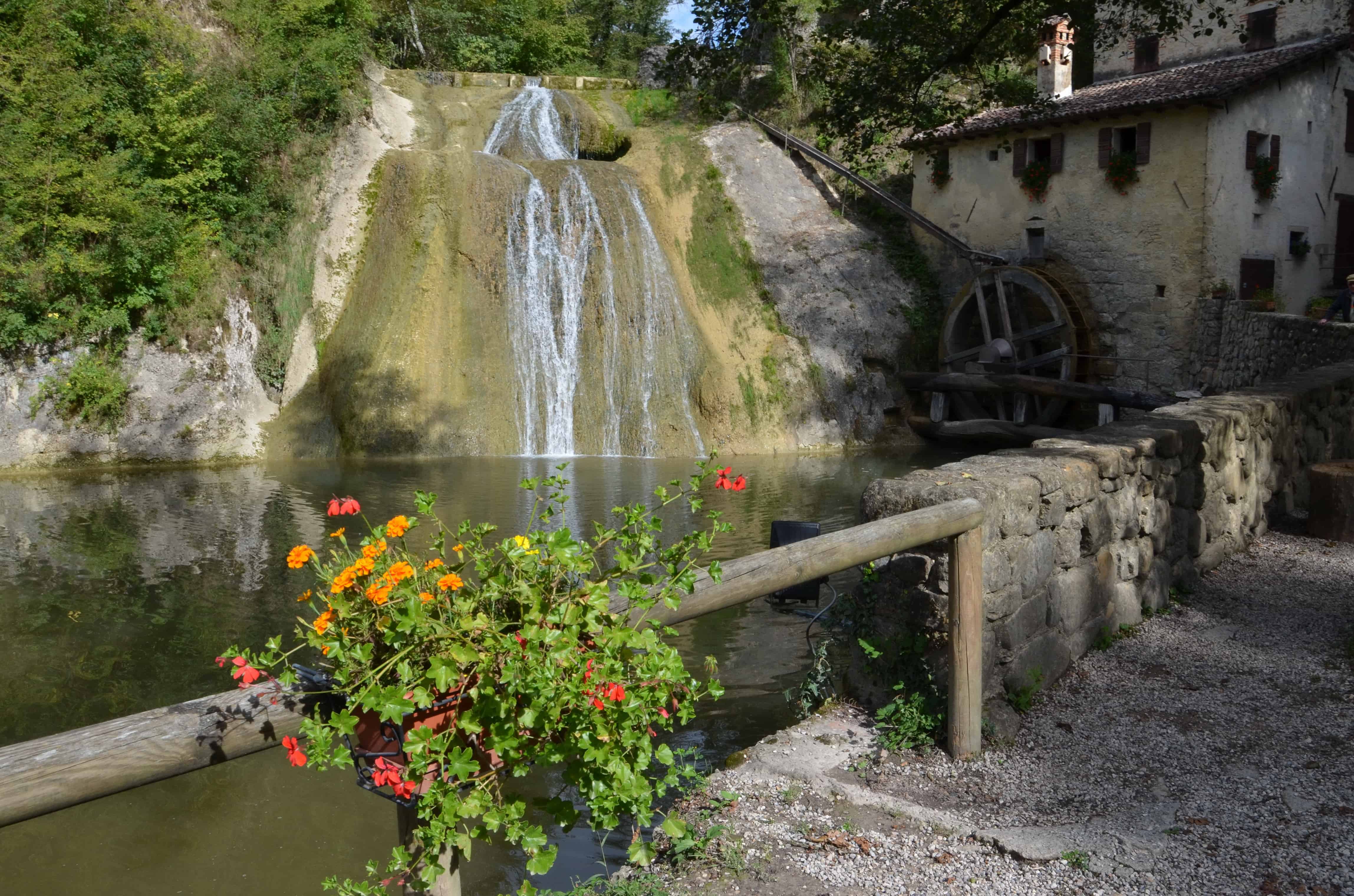
I have ridden this road so many times that I stop counting the kilometres and start counting the things I see. The buzzards riding the morning thermals above the Cartizze hill. The old man pruning his vines at Rolle with the Dolomites behind him, snowcapped still in April, the peaks catching the early light. The sound of water in the gorge near the Molinetto della Croda before the mill comes into view around the bend — the overshot wheel, the waterfall, the ferns growing in the spray. Cycling the Prosecco Hills in spring has a quality that I find it genuinely difficult to describe to people who have not done it, because the experience arrives in fragments of sensation rather than in a continuous narrative, and each fragment belongs to that specific moment, that light, that gradient, that smell of the earth after rain on a hillside planted with Glera that is just starting to wake after winter.
What I can tell you is this: of all the cycling that this part of northeast Italy offers — and the province of Treviso is outstanding cycling territory, with routes from the flat Piave plain to the first Dolomite foothills — the Strada del Prosecco between Conegliano and Valdobbiadene is the one I return to most reliably in spring, because spring is when the landscape shows you something that no other season can. The vines are just starting to bud. The villages are quiet. The Primavera del Prosecco Superiore festival runs from mid-March to mid-June, meaning that at almost every point on the route there is a wine producer pouring new releases and a Pro Loco laying out local food in a courtyard somewhere nearby. And the Dolomites, still white, anchor the northern horizon with a clarity that summer haze will obscure within weeks.
This article gives you the route, the stops, the practical information, and the honest assessment of difficulty that I wish every cycling guide in this territory provided. Read it before you ride.
The Territory: What You’re Cycling Through
The Prosecco Hills — formally, the Colline del Prosecco di Conegliano e Valdobbiadene — were inscribed as a UNESCO World Heritage Site on July 7, 2019. The UNESCO committee’s rationale was specific and worth understanding before you arrive: what earned the designation was not just beauty but the relationship between a challenging landscape and the people who have shaped it over four centuries.
The geology is what the UNESCO description calls “hogback” morphology — steep, rounded ridges running east-west, separated by narrow valleys, the whole system squeezed between the Piave River to the south and the pre-Alps to the north. These are not gentle, accommodating hills. The slopes are genuinely difficult: in many vineyards, gradients exceed thirty percent, making mechanization impossible and requiring all pruning, training, and harvest to be done by hand by people who have learned to move on steep, slippery ground carrying equipment and grapes. This is what viticulture researchers call “heroic farming” — agriculture practiced in conditions that no rational economic calculus would endorse, sustained by tradition, identity, and the specific character of the wine that only this land, worked in this way, produces.
The adaptation that the farmers of this territory developed over the seventeenth century was the ciglione — narrow grassy terraces cut into the hillsides horizontally, following the contour lines, stabilizing the slope and creating the checkerboard pattern of vine rows alternately parallel and perpendicular to the gradient that UNESCO describes as the landscape’s defining visual characteristic. Walk up through any vineyard on the Strada del Prosecco in spring and you will feel the ciglioni under your feet: the tufts of grass between the vine rows, the slight drop at each terrace edge, the specific rhythm of the slope that distinguishes this territory from any other wine landscape I have seen.
In the nineteenth century, local farmers developed a vine training system called bellussera — named for the Bellussera family who are credited with its invention around 1880 — in which the canes are fanned outward and upward from the vine stock in a spreading canopy that gives the hillsides their characteristic appearance in summer: rows of vine arches like a series of inverted fans, the bunches of Glera hanging in the cool air beneath the leaf cover. In spring, before the leaves open fully, you see the frame of the bellussera training against the sky in the early morning — the bare canes radiating from each stock, the wires catching the light — and it has an abstract beauty that the full summer growth conceals.
The Glera grape is the dominant variety throughout the territory — it must constitute at least eighty-five percent of any wine labeled Conegliano Valdobbiadene Prosecco Superiore DOCG. But Glera is not a single expression here: the soils vary from the sandy marl of the western hills near Valdobbiadene to the reddish clay and stone of the central ridges to the gentler, sandier terrain of the eastern slopes near Conegliano, and the wine produced in each sub-zone has a distinct character that the DOCG’s Rive classification — forty-three single-vineyard or single-commune cru designations, approved in 2009 — is designed to capture and protect.
The qualitative apex of the entire denomination is the Cartizze: a south-facing hill of 107 hectares in the municipality of Valdobbiadene, producing what the consortium calls, without false modesty, the grand cru of Prosecco. The soils here are shallow marl and sandstone with limestone — the geology that the fossil-shell fragments embedded in the rock record. The pre-Alps to the north shelter the hill from cold northeastern winds. A gentle east-west breeze keeps the grapes dry through the growing season. The steepness of the slopes — impossible for any machinery, worked exclusively by hand and by foot — limits yields to levels that concentrate the character of the Glera grape beyond what the wider DOCG achieves. There are approximately 145 producers farming the Cartizze hill. Many have been doing so for generations. Cycling past the Cartizze vineyards in spring — the neat rows on their impossibly steep ciglioni, the Dolomites above, the valley floor far below — is one of those experiences that makes the concept of terroir concrete rather than abstract.
The Route: Conegliano to Valdobbiadene
The Strada del Prosecco — formally, La Strada del Prosecco e Vini dei Colli Conegliano Valdobbiadene — is the world’s first designated wine road, established in 1966, running approximately 105 kilometers through fifteen municipalities between Conegliano in the east and Valdobbiadene in the west. It is a complete loop; both Conegliano and Valdobbiadene have train stations with frequent services to Treviso (twenty minutes) and Venice (approximately one hour), making a point-to-point ride between the two an entirely practical proposition for cyclists arriving by public transport.
The route described here runs west from Conegliano to Valdobbiadene, which gives you the more demanding climbing in the middle section — the approaches to Follina and Cison di Valmarino — with the day ending in Valdobbiadene at the western edge of the DOCG, where the Cartizze hill and the Osteria Senz’Oste provide a finale proportionate to the effort. The total distance is approximately 55 kilometers in the version I describe here, following the Strada del Prosecco through the principal villages; a longer version of 80+ kilometers is possible for riders who want to explore the higher elevation roads above the vineyards.
Difficulty: The route is genuinely hilly. Cumulative elevation gain on the standard version runs to approximately 900–1,100 meters, with several climbs that reach eight to twelve percent gradient. For a fit recreational cyclist on a standard road or gravel bike, this is a challenging but manageable day. For anyone who finds sustained climbing difficult, an e-bike is not a compromise but a specific advantage: the assistance allows you to control your effort on the steeper pitches and spend more energy on looking at the landscape and less on managing your breathing. Bike rental — including quality e-bikes — is available in both Conegliano and Valdobbiadene through operators including Italy Cycling Tour (italycyclingtour.it), whose base on the Strada del Prosecco includes shuttle transfers if you want to ride one direction only.
Spring road conditions: The secondary roads through the vineyards are generally well-maintained tarmac, with occasional stretches of compacted gravel above the main route. In early spring (March–early April) some of the higher tracks above Follina and Cison can be soft after rain; a gravel bike handles these sections better than a pure road bike, though road bikes are manageable on the main Strada del Prosecco route. Cycling traffic on the Strada del Prosecco is significant in summer but light in spring, which is one of the practical advantages of the season in addition to the landscape and the temperatures.
The Stages
Conegliano: The Start
Conegliano is a town of approximately 35,000 inhabitants at the eastern end of the DOCG, easily reached by train from Treviso in twenty minutes or from Venice in approximately fifty minutes. The town’s castle, perched on the hill above the historic centre, houses a small museum with views across the Prosecco hills toward the Dolomites that reward a brief climb before you saddle up. The Sala dei Battuti — the Hall of the Flagellants — in the former confraternity building adjacent to the Cathedral contains one of the most remarkable examples of late medieval and Renaissance fresco painting in the Treviso province: a complete pictorial cycle covering walls and ceiling that most visitors to the territory entirely miss. Conegliano is also home to Carpenè Malvolti, the winery founded in 1868 by Antonio Carpenè and credited with establishing the commercial production of Prosecco as a sparkling wine — the starting point of the story that ends with UNESCO inscription 151 years later.
Leave Conegliano on the SP38 heading west, dropping to the valley floor and beginning the characteristic rhythm of the Strada del Prosecco: short climbs over the hogback ridges, descents into the narrow valleys between them, vine rows on every south-facing slope, small villages on the crests.
San Pietro di Feletto
Approximately twelve kilometers from Conegliano, the village of San Pietro di Feletto sits on a ridge with views north toward the Dolomites and south toward the Piave plain. The parish church — the antica Pieve romanica — is a Romanesque building of the eleventh and twelfth centuries with an external arcade that functioned as a loggia for outdoor Masses when the congregation exceeded the building’s capacity, a practical adaptation that is also architecturally beautiful. Inside, medieval frescoes cover the walls with a completeness that is unusual for a rural church of this size. The spring light through the Romanesque windows, when the church is open, is worth a fifteen-minute stop.
Refrontolo and the Molinetto della Croda
The descent from the San Pietro ridge toward Refrontolo is one of the most photographed views on the Strada del Prosecco: the valley opens below you with vine terraces on every slope, the medieval tower of Refrontolo visible on the ridge ahead, and on a clear spring morning the Dolomites forming the entire northern wall. The Molinetto della Croda — the Little Mill on the Rock — is in Refrontolo, reached by a short deviation from the main route down to the Lierza stream. It is a working overshot watermill built in 1630, restored in the twentieth century, set into a gorge where the stream drops approximately twelve meters in a waterfall directly beside the mill wheel. The ferns grow in the spray. The sound of the water is audible before you see the building. Stop here. Eat something from the farm stand if it is open. This is not a tourist reconstruction — it is a functional building in a landscape that has looked substantially the same for four centuries.
Rolle
Rolle is one of those villages that exists almost entirely to prove that a place can be more beautiful than it has any right to be given its size. A handful of stone buildings on a ridge above a valley, surrounded by terraced vineyards in every direction, with views that on a spring morning — the Dolomites still white, the valley floor green, the vine rows beginning to bud — belong to the category of experiences that make the effort of arriving by bicycle under your own power feel specifically worthwhile. There is no dramatic architectural monument here, no museum, no event. There is a village, a view, and the particular quality of silence that comes from being at altitude above a valley with no road noise and only the sound of the wind in the vines.
Follina: The Abbey
Follina is one of the Borghi più Belli d’Italia — the national register of Italy’s most beautiful villages — and it earns the designation without controversy. The Cistercian Abbey of Santa Maria dominates the village: a complex founded in the twelfth century on an earlier Benedictine establishment, rebuilt and expanded over the thirteenth and fourteenth centuries, damaged and restored over the subsequent seven hundred years, and currently serving as the parish church of Follina as it has for most of its existence. The facade is Cistercian Gothic: white stone, pointed arches, the simplicity that the Cistercian rule demanded as a corrective to Benedictine elaboration. The cloister — completed in 1268, older than the church it adjoins — is a Romanesque arcade of paired columns around a central fountain of octagonal plan, each capital carved in the local stone with ornamental motifs that are similar in vocabulary but individually distinct: a sustained exercise in variation within constraint that feels thoroughly contemporary.
The interior contains a 1527 fresco by Francesco da Milano, a large Baroque wooden crucifix, and a sandstone statue of the Madonna del Sacro Calice that has been an object of pilgrimage for six centuries. The abbey was connected to Chiaravalle and Cîteaux — the founding houses of the Cistercian order — for most of its medieval history, and passed to the Republic of Venice in 1388. Its location in the valley between the Prealps and the Prosecco hills made it, for centuries, a center of wool processing and silk production as well as a spiritual community: the name Follina derives from the follatura — the fulling of wool — that the streams of the Fulina valley powered throughout the Middle Ages.
Eat lunch in Follina. The village has several restaurants operating on seasonal menus that the spring larder of this territory supports: asparagus from the Piave plain, local cheeses, the first of the spring greens. A glass of Valdobbiadene Prosecco Superiore DOCG with the food, in the square in front of the abbey, with the Cistercian facade in front of you and the vine-covered hills behind, is one of those combinations that functions as an argument for the entire concept of cycling tourism.
Cison di Valmarino and CastelBrando
Four kilometers from Follina, the village of Cison di Valmarino sits below the imposing bulk of Castello Brandolini — known universally as CastelBrando — which rises from a rocky promontory above the Valmareno valley with the authority of a building that has been controlling the access routes through this territory since the medieval period. The castle’s history runs from its origins as a Venetian strategic asset — it passed to the Republic of Venice in 1436, when the condottiere Brandolino Brandolini acquired it after the wars against the Sforza — through its sixteenth-century transformation from military fortress to aristocratic residence and its eventual conversion in the late twentieth century into a luxury hotel. The exterior and gardens are accessible to non-guests; the cable car that carries hotel guests from the valley floor to the castle entrance operates periodically and gives a glimpse of the vertical relationship between the valley and the hilltop that the castle’s medieval builders exploited for visibility and defense.
Cison’s Via dell’Acqua — the Water Road — follows the Rujo stream through the village and beyond into the woods, passing the remains of mills, water-powered looms, and forges that operated from the sixteenth to the nineteenth century. In spring, with the stream running full from snowmelt and rain, the path through the gorge is one of the most beautiful short walks in the entire territory. It is worth leaving your bike in the village and spending forty minutes on foot.
The Cartizze and Valdobbiadene
The approach to Valdobbiadene from the east takes you through the heart of the DOCG, past sub-zones whose names appear on the best bottles produced in this territory — Col San Martino, Guia, San Pietro di Barbozza — and then up and over the Cartizze hill itself, if you take the climbing variant of the route. The Cartizze road ascends directly from the valley floor to the hilltop through a vineyard that has no room for a car passing in the opposite direction: a single track between vine rows on ciglioni so steep that you can see the valley floor between the vines at your feet and the Dolomites at eye level simultaneously.
At the top, the Osteria Senz’Oste — the Inn Without an Innkeeper — is one of the most intelligently conceived food and wine installations in the territory: a farmhouse building on the Cartizze hilltop where local bread, salumi, cheeses, and bottles of wine are left on shelves with prices marked, to be taken and paid for at an automated kiosk. Tables outside face south across the valley toward the Piave and, beyond it, the Venetian plain. You serve yourself, you eat, you pay what is owed. The honor-system economy of this place feels entirely appropriate to a hillside where wine has been made by people who trust the land and each other for four hundred years.
Descend to Valdobbiadene, where the town’s main square, several enoteca, and the train station (trains to Treviso via Montebelluna, approximately forty-five minutes) provide the practical necessities of the end of a day’s riding.
Spring on the Strada del Prosecco: The Specific Advantages
The Primavera del Prosecco Superiore — the spring festival of the DOCG — runs from March 13 to June 14, 2026. Across the fifteen municipalities of the denomination, seventeen Mostre del Vino (wine exhibitions) open during this period, each organized by the local Pro Loco in coordination with the producers of that commune. Entry typically costs €5–10 and includes a glass; the wines poured are the new releases from the previous October harvest, the wines at their freshest and most expressive. The atmosphere at the Mostre is local: the people pouring the wine are the people who made it, and the conversations that develop over a glass at a Mostra in Follina or Col San Martino in April have a specificity that no wine fair in a city can replicate.
For cyclists, the Primavera calendar means that on almost any weekend between mid-March and mid-June, a Mostra or producer open day is within reach of any point on the Strada del Prosecco. The practical logistics require planning — check the programme at the Consorzio’s website (coneglianovaldobbiadene.it) and at visitproseccohills.it before you ride, identify which Mostra falls on your weekend, and build your route to include it. A Saturday ride that ends at a Mostra in Col San Martino or Santo Stefano, where the first Cartizze is poured each March, is a very specific reward for a very specific effort, and I recommend it without qualification.
Spring temperatures — typically 12–18°C in April across the hills, warmer in the valleys — make for cycling conditions that summer cannot match: cool enough to climb comfortably, warm enough to sit outside at lunch without a jacket, clear enough (usually) to see the Dolomites that summer haze obscures. Rain is possible; the hills create their own weather patterns and afternoon showers are common in April and May. Carry a light waterproof. The wet-road descents through the vine terraces require more care than dry ones, and the unpaved sections near Follina and the higher Cison roads become genuinely slippery.
Getting to the Start
Conegliano is the recommended starting point for cyclists coming from Treviso: direct trains run approximately every twenty minutes from Treviso Centrale, the journey takes approximately twenty minutes, and the walk from Conegliano station to the beginning of the Strada del Prosecco is under five minutes. From Treviso airport, the MOM Line 6 bus connects to Treviso Centrale, from which you take the train to Conegliano. From Venice Santa Lucia, the train to Conegliano takes approximately fifty minutes with a change at Mestre or a direct regional service.
Bikes are permitted on regional trains in Italy subject to the standard Trenitalia bicycle ticket (a small additional charge). Folding bikes travel free. On busy weekend services in spring, securing a space for a full-size bike in the designated bicycle compartment may require booking in advance at the ticket machine or via the Trenitalia app.
Bike rental in Conegliano and Valdobbiadene is available through Italy Cycling Tour (italycyclingtour.it), which operates on the Strada del Prosecco and offers road bikes, gravel bikes, e-bikes, and shuttle transfers between start and end points if you want to ride one direction only. Book in advance for spring weekends.
Accommodation on the Route
The Strada del Prosecco has a network of agriturismi, small hotels, and guesthouses in or near the principal villages. CastelBrando in Cison di Valmarino is the most dramatic overnight option — a castle hotel with a spa, accessible by cable car — and books far in advance for spring weekends. Alternatives in the same price tier include the Relais Ca’ del Poggio near San Pietro di Feletto and the Locanda Sandi in Valdobbiadene. More modest and better value for cyclists: the agriturismi scattered through the vineyards between Follina and Cison, where the owners are typically producers whose wine is poured at breakfast and dinner, and where the conversation about the land you rode through the day before is the natural topic of the table.
For visitors using Treviso as a base and riding the Strada del Prosecco as a day trip — entirely feasible, with Conegliano forty minutes from Treviso by train — the logistics are straightforward. Leave Treviso by the 8:30am train, begin riding by nine-thirty, reach Valdobbiadene by early evening, and take the Montebelluna train back to Treviso in time for aperitivo. The day’s riding, the abbey at Follina, the Molinetto della Croda, the Cartizze hill, and the Osteria Senz’Oste — this is a complete experience in a single day, and the train home at dusk through the Piave valley, with the hills you rode already in shadow, has its own specific satisfaction.
📩 I organize guided cycling days on the Strada del Prosecco in spring, including route planning, producer introductions, and Mostra del Prosecco visits timed to the Primavera del Prosecco Superiore programme. For groups of two to eight, I combine the cycling with wine education and, where possible, visits to small family estates not open to general tourism. Get in touch to plan your spring cycling day in the Prosecco hills.
Frequently Asked Questions
Do I need to be a strong cyclist to ride the Strada del Prosecco?
The honest answer is that the Strada del Prosecco is a genuinely hilly route with significant cumulative climbing, and a standard road or gravel bike requires a basic level of cycling fitness to handle the steeper pitches comfortably. That said, the e-bike option changes this entirely. A quality e-bike with pedal assist handles the Cartizze climb and the approaches to Follina and Cison without putting a recreational cyclist under the kind of physical pressure that prevents them from looking at the landscape. I have guided cyclists on this route ranging from competitive club riders to people in their seventies who had not ridden seriously in a decade, and the e-bike option made the route accessible to everyone in the second group. If you have any doubt about your climbing fitness, choose an e-bike. You will enjoy the ride more and see more, because you will not be spending the climbs looking at your wheel. Bike rental operators on the route, including Italy Cycling Tour, provide quality e-bikes with sufficient battery range for the full day.
What is the best time of year to cycle the Strada del Prosecco?
I consistently recommend April and early May as the optimal period, for a combination of reasons that no other season replicates. The vines are in early bud or full spring growth — the bellussera training visible in its full geometric clarity before the leaf cover thickens. The Primavera del Prosecco Superiore programme means that Mostre are open across the territory, offering access to new releases in the places where they were produced. The temperature is cool enough for comfortable sustained cycling. The Dolomites are still snow-capped and visible on clear days, providing the northern horizon that summer haze removes. And the crowds that arrive in summer and autumn — particularly during harvest in September and October, which is beautiful but busy — have not yet materialized, meaning that the villages and osterias are operating for local rather than tourist traffic and the experience is correspondingly more intimate. Late March is possible and catches the very end of the radicchio season alongside the first asparagus, but the vine growth is minimal at that point and some agriturismi and smaller restaurants have not yet opened for the spring season. Early June is excellent but already warm; later in June, the summer heat arrives and the Dolomites disappear behind haze.
Can I visit wine producers on the route without a pre-arranged appointment?
Some producers on the Strada del Prosecco have tasting rooms that operate on a walk-in basis during spring, particularly during the Primavera del Prosecco Superiore period when the Mostre del Vino are running — the Mostre are explicitly public events requiring no appointment, with a small entry fee covering a glass and access to a curated selection of wines from that commune’s producers. For visits to specific estates, particularly the smaller family producers in the five-to-fifteen hectare range that I find most interesting from a wine perspective, advance contact is strongly recommended and in many cases required. These are working farms, not visitor centers, and the winemaker who is available to pour wine and talk about their Rive on a Tuesday morning may be in the vineyard and unavailable on a Saturday afternoon in April. I can make introductions to producers I know personally — people who will pour you something from the barrel and explain the specific slope you are looking at from their terrace — but this requires planning in advance. The difference between a Mostra tasting and a morning at a small estate with the producer is the difference between understanding Prosecco Superiore as a category and understanding what this specific hill, in this specific family’s hands, tastes like. Read more about the Prosecco Road and the distinctions between Prosecco Superiore DOCG and Prosecco DOC before you visit — the terminology matters, and understanding it before you arrive changes what you taste.
Igor Scomparin is a licensed Tour Guide and Tour Leader for the Veneto Region, certified Travel Agency Director, and founder of tourleadertreviso.com. He has been featured in Rick Steves’ travel guides to Italy and Europe since 2008.