Primavera in Festa at Roncade: The March Market That Celebrates the Piave and Its Wines
There is a Sunday in March — this year it falls on March 8, 2026 — when the main street of Roncade fills with producers, market stalls, cheese makers, flag throwers, a brass band, and the smell of something cooking that you will not find anywhere else at this precise moment of the year. The event is called Primavera in Festa. The occasion is the Radicchio Verdon di Roncade and the red wines of the Piave. The town is about twenty kilometres east of Treviso, on the flat agricultural plain between the city and the Venetian lagoon, and it is not a place that appears on most visitors’ itineraries.
It should.
I am Igor Scomparin. I have held an official Tour Guide License for the Veneto region since 2007, and I have been watching events like Primavera in Festa with appreciation for nearly two decades — not because they are designed for tourists, which they are not, but precisely because they are not. These are the occasions when a community comes together to celebrate something specific about where it lives: a vegetable that grows here and nowhere else in quite the same way, and a wine that comes from the river that defines this landscape. That combination, on a Sunday morning in March, is one of the most honest expressions of Veneto food culture available to anyone who wants to find it.
What Primavera in Festa Actually Is
The event is organised by the Pro Loco di Roncade — the local civic association that has run community events in this town for decades — in collaboration with the Distretto Urbano del Commercio Roncadese, Confartigianato Treviso, and with the support of the municipal government. It has been running for many years and is part of the wider Fiori d’Inverno rassegna — the long winter festival that celebrates the Radicchio Rosso Tardivo IGP and its relatives across the Treviso and Venice provinces from November through mid-March.
The 2026 edition runs across two Sundays. The first Sunday, March 8, is dedicated to the Radicchio Verdon and the red wines of the Piave. The official opening is at 10.30 in the morning with the cutting of the ribbon, the municipal band, the conferral of certificates to the producers of Verdon and the Piave wines, and the formal recognition of the Verdon’s DE.CO. designation — the Denominazione Comunale, the municipal quality mark that certifies this radicchio as a product of Roncade specifically. The second Sunday, March 15, shifts focus toward the local craft fair — the Fiera dell’Artigianato — though the Verdon remains present throughout.
Throughout the first Sunday, the main street becomes a long market of direct producers: growers selling the Verdon at the stand, wine producers presenting the red wines of the Piave DOC zone, cheese makers from the surrounding area, local food producers with sausages and pasta and the prepared foods that the Veneto does so well. The Alpini of Roncade — the local veterans’ association that runs the gastronomy at community events across the province with a reliability and seriousness that I find deeply admirable — serve a menu built around the Verdon. Guided wine tastings, organised by FISAR sommeliers in the afternoon, focus specifically on the Merlot of the Piave denomination.
There are flag throwers from Noale. There is a demonstration of traditional crafts by the local ecological group. There are pony rides for children and country music from a local group and, somewhere in all of it, the particular quality of a community that is showing you who it is rather than performing for an audience.
Around the perimeter of the main market, the entire month of March extends the event into a circuit of themed evenings at restaurants in the provinces of Treviso and Venice — osterie and agriturismi that build menus around the Verdon and the Piave wines for the whole month, creating what amounts to a rolling celebration of this specific corner of the Veneto table.
The Radicchio Verdon: The One You Haven’t Heard Of
Most people who know anything about Treviso radicchio know the Radicchio Rosso Tardivo IGP — the forced red radicchio with its white-ribbed leaves and bitter winter character that has been celebrated across Italy and internationally for decades. Some people know the Variegato di Castelfranco, the round, creamy-red speckled radicchio that the Veneto calls the flower of the table.
Very few people outside the Treviso province know the Radicchio Verdon di Roncade.
The Verdon is a different creature entirely. It is green — intensely, specifically green, the colour of spring rather than winter — with a small, tight rosette shape and a yellow heart at its centre. That yellow heart is the identifying mark: if you see a green radicchio with a yellow centre, you are looking at a Verdon. If you see something green that looks similar but lacks that yellow heart, you are looking at one of its less distinguished relatives — the Monselice, the Verdolino, the Verde chiaro — which resemble the Verdon superficially but lack its particular organoleptic character.
The Verdon is a product of the specific conditions of Roncade and its immediate territory. The flat plain here, close to the Sile River and the edge of the lagoon, produces a particular quality of soil and water that the Verdon has adapted to over generations. It is cultivated by a small number of producers who work the land around the town, and it is available for a short window in late winter and early spring — March is the moment when it is at its best. The DE.CO. designation, the municipal certificate of origin that the Comune di Roncade confers formally at the Primavera in Festa opening ceremony, exists precisely to protect this specificity: to distinguish the genuine Verdon di Roncade from the lookalike varieties that might otherwise be passed off as the same thing.
In the kitchen, the Verdon performs differently from the red radicchio. It is less bitter, more tender, with a clean vegetable character that works well raw in salads — particularly with anchovies, capers, and hard-boiled eggs, a combination that the Veneto has used for generations — and equally well cooked. The tortelli and risotti and pasta dishes that the Roncade restaurants serve throughout March during the themed evenings are built around this versatility: the Verdon holds its texture when cooked, takes flavour well, and has enough character to carry a dish without being overwhelmed by the other ingredients.
The pairing with the red wines of the Piave is not accidental. The Verdon’s bitterness, mild as it is compared to the Tardivo, is exactly the kind of vegetable note that a structured red wine handles well. The two products come from the same landscape — the alluvial plain of the Piave river system, the flat land between Treviso and the lagoon — and they have been eaten together in this territory for as long as both have been produced here.
The Red Wines of the Piave: A Wine Italy Has Not Yet Discovered
When most people think of wine from the Treviso province, they think of Prosecco. The Conegliano Valdobbiadene hills, the UNESCO landscape, the Glera grape, the bubbles — this is the wine story of the Treviso province that has been successfully communicated to the world. And it is a great story, one I tell with genuine pride on my Prosecco Road tours.
But the Piave DOC wines are a different story, told to a much smaller audience, and I think they deserve more attention than they currently receive outside Italy.
The Piave DOC zone covers an extensive area on the flat plain between the pre-Alpine foothills and the Adriatic, following the course of the Piave River through the provinces of Treviso and Venice. The soils here are alluvial — deposited over millennia by the river flooding and receding, leaving a matrix of gravel, sand, and clay that provides excellent drainage and a particular mineral character to the grapes grown in it. The summers are warm and dry, the winters cold enough to reset the vines, and the diurnal temperature swings that characterise this continental-influenced climate preserve acidity in the fruit.
The red wines produced in the Piave DOC zone are primarily Merlot, Cabernet Sauvignon, Cabernet Franc, and — the one that matters most for understanding this territory — Raboso Piave.
Merlot arrived in the Veneto in the nineteenth century and has become, over the generations, something close to an adopted native. The Merlot of the Piave plain is not the soft, approachable international style of much Italian Merlot. It has more structure, more tannin, more of the mineral and herbal notes that the alluvial soils and the cool winters impose on the grape. The best examples are wines of genuine substance — the kind of red that suits the Veneto table of braised meats, aged cheeses, and exactly the kind of bitter vegetable character that the Verdon represents. The FISAR guided tastings at Primavera in Festa, which focus specifically on identifying the best Merlot of the denomination, take this seriously: there is a prize, a genuinely contested prize, for the finest expression in the current vintage.
But the wine that makes the Piave DOC irreplaceable — the wine that exists nowhere else, that cannot be replicated outside this specific territory — is the Raboso Piave.
The Raboso is one of the most ancient and most demanding grape varieties in the Veneto. It has been cultivated in this territory for centuries — some historians believe it may be identifiable in the ancient Roman sources on the wines of the Venetian plain, though this is contested. The name almost certainly derives from the Veneto dialect word rabbioso — angry, fierce — which describes the grape’s character with uncomfortable precision. The Raboso produces a wine of deep ruby colour, intense aromatics of black cherry, marasca, wild bramble, and the faintest suggestions of leather and spice, and a palate structure that is, in youth, genuinely challenging: high acidity, aggressive tannin, a combination that made the wine, for several decades in the twentieth century, deeply unfashionable.
That unfashionability was a mistake, and a growing number of producers and drinkers in Italy are recognising it. The Raboso’s combination of high acid and powerful tannin — the very quality that made it seem rustic and difficult — is also the quality that allows it to age for decades and to pair with food in ways that the softer international varieties cannot. In the era of the Venetian Republic, it was known as the vin da viajo — the travel wine — because its extraordinary structure meant it could survive the holds of ships crossing the Mediterranean without oxidising or spoiling. Merchants in Seventeenth-century Venice drank it in quantities precisely because it kept. The same qualities that made it a practical choice for sea voyages make it, with some years in oak barrel, a wine of remarkable depth and complexity.
The Malanotte del Piave DOCG — the highest-quality designation for Raboso-based wines, requiring a minimum aging period and a specific production protocol — represents the apex of what this grape can achieve. But the DOC Piave Raboso presented at Primavera in Festa gives you the essential character of the variety: the fierce freshness, the dark fruit, the mineral edge, the tannin that will outlast most of the wines you own.
This is a wine that rewards patience and rewards knowledge. If you taste it young, without context, it can seem harsh. Taste it with a plate of roasted meat or a selection of aged cheese, or with a risotto built around the Verdon, and something clicks into place. The bitterness in the vegetable meets the tannin in the wine, the acidity of both animate the palate, and you understand why these two products have been paired in this territory for as long as anyone can remember.
Roncade: The Village and the Castle
Roncade itself deserves a word, because it is not merely a market venue. It is a small town with a genuinely distinguished historic centre — a medieval and Renaissance fabric that has remained largely intact precisely because it was never large enough to attract the kind of twentieth-century redevelopment that changed the face of many Veneto towns.
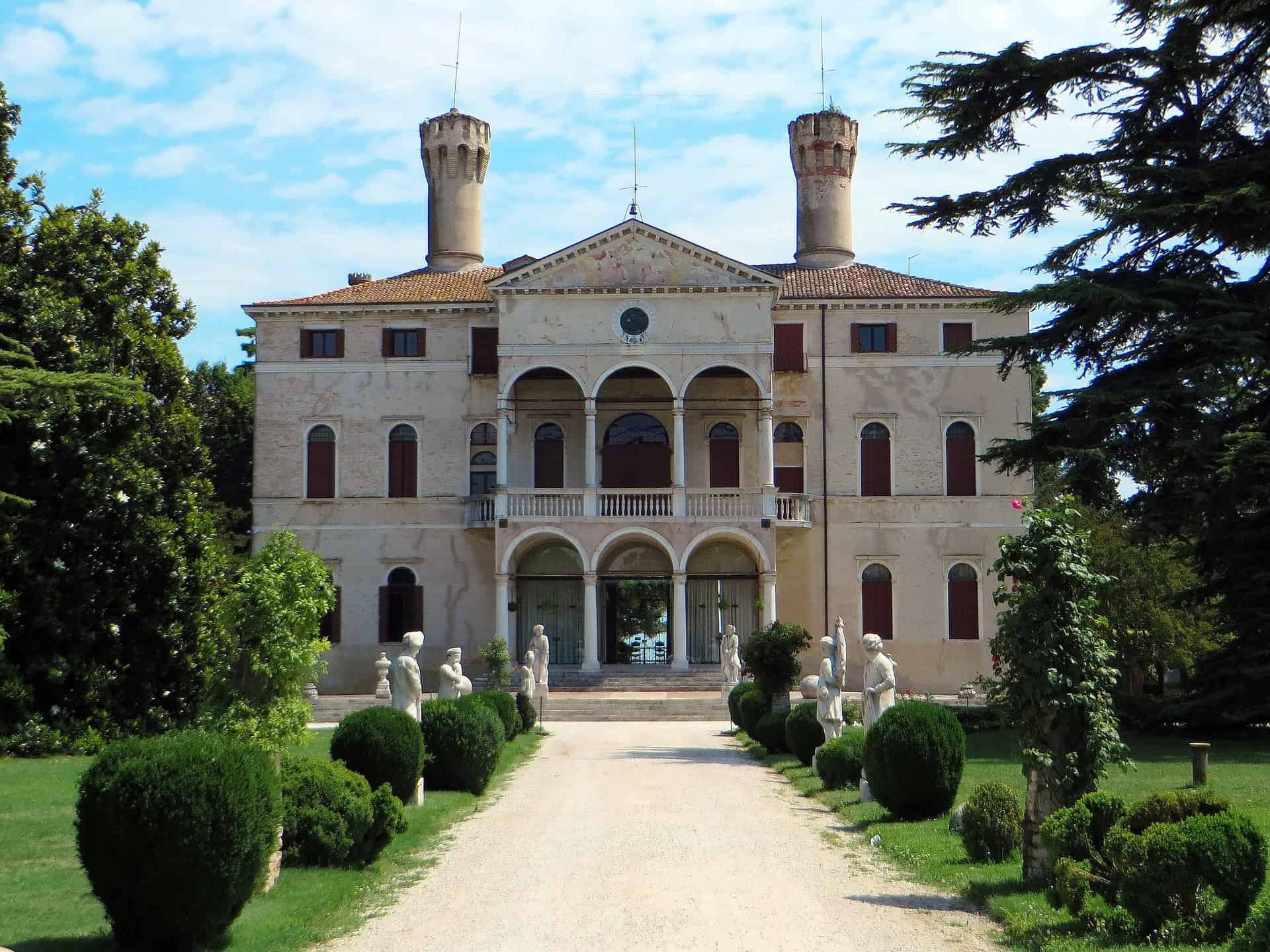
The most dramatic structure is the Villa Giustinian, a fifteenth-century fortified villa with crenellated towers and a genuine moat that is one of the more extraordinary examples of the Venetian noble villa type in the province. Most Palladian villas and Venetian country houses in the Veneto are graceful affairs of white render and classical proportions. The Villa Giustinian at Roncade is something older and more assertive — a building that looks like it was designed to be defended as well as inhabited, with the medieval fortress vocabulary of the commune period still visible in its massing and its towers. It is still a working wine estate, producing Piave DOC wines from the vineyards that surround it, and it is visible from the road that runs through the centre of the town.
The village is also part of the territory of the Parco Regionale del Fiume Sile — the regional park of the Sile River — and the wetland and riparian landscape of the lower Sile, where the river broadens and slows as it approaches the lagoon, is accessible on foot and bicycle from the town. In March, with the willows beginning to show their first green and the water birds active in the reed beds, this is one of the more quietly beautiful walks available in the Treviso province without significant physical effort. The same spring water system that flows through the upper Sile near Treviso reaches its conclusion in this lower territory, the river having widened and slowed from the quick, clear current of its source into something broader and more contemplative.
How to Approach Primavera in Festa as a Visitor
The event is free. There is no entrance charge, no ticket, no registration required. You arrive in the centre of Roncade on Sunday morning — the event is concentrated on Via Roma and the main square — and you walk into a working market that is entirely oriented toward the people who live in this territory.
This is worth noting because it changes how you should approach it. Primavera in Festa is not a festival designed for visitors. It is a community event that visitors are welcome to attend, which is a different thing. The producers speak Veneto dialect among themselves. The Alpini serve food at tables shared with local families. The brass band plays for people who know the music. You are not being guided through an experience; you are being offered the chance to observe and participate in one that exists independently of your presence.
What this means in practice: arrive without expectations of translation or interpretation. Go to the producers’ stalls and point at what you want to taste. Accept the glass of wine offered with the confidence of someone who is glad to be there. Ask, if you can, what is in the dish — the combination of hand gestures and shared vocabulary that Italians and foreign visitors have been using to communicate across the kitchen counter for centuries works perfectly well here.
Arrive by ten in the morning to catch the official opening ceremony with the band and the certificate presentations. Spend the late morning at the producers’ stalls, tasting the Verdon in its raw form before you eat it cooked. Have lunch with the Alpini — the menu will be built around the Verdon and it will be exactly the right food for the day. In the afternoon, attend the FISAR sommelier-led Merlot tasting if it is offered, which will give you a structured comparison of the wines of the denomination. Leave in the late afternoon having eaten and drunk things you could not have found anywhere else on this particular day of the year.
Roncade is twenty kilometres from Treviso on the road toward Venice — about twenty-five minutes by car, accessible in principle by public bus though a car gives you far more flexibility. If you combine the event with a morning visit to Treviso’s canal district before driving east to Roncade, you have a full Sunday that moves between the city and the plain, between the canals and the agricultural landscape, between the aperitivo culture of the city and the market culture of the village. That movement — the way the Treviso province contains both of these things within thirty minutes of each other — is one of the things I find most satisfying about this territory.
📩 I include the Primavera in Festa at Roncade in my March itineraries for guests who want to experience the real food culture of the Treviso plain. Get in touch to arrange a guided Sunday that combines Treviso’s historic centre with the Roncade market and the lower Sile landscape.
Frequently Asked Questions
What exactly is the Radicchio Verdon di Roncade, and how is it different from other Treviso radicchio?
The Radicchio Verdon di Roncade is a green variety of radicchio — a chicory — that is specific to the territory around Roncade, on the alluvial plain east of Treviso near the lower Sile River. It is distinguished from similar-looking green varieties by its compact rosette shape and, critically, its yellow heart, which identifies it as the genuine Verdon rather than the less prestigious relatives that resemble it superficially. The Comune di Roncade protects it with a DE.CO. designation — a municipal certificate of origin — and the Primavera in Festa event exists specifically to celebrate and promote it. In terms of flavour, it is less bitter than the Radicchio Rosso Tardivo IGP, more tender in texture, and more versatile in the kitchen — it works well raw in salads and cooked in risotti, pasta, and the stuffed preparations that Veneto cooks have developed for it over generations. March is the optimal moment to eat it, which is why the event is scheduled when it is. The Verdon is not a radicchio you are likely to encounter outside the Treviso and Venice provinces, which makes Primavera in Festa one of the few opportunities available to taste it in its own territory. My article on the Fiori d’Inverno festival gives more context on how the Verdon fits into the wider winter radicchio culture of the province.
What are the red wines of the Piave DOC, and are they worth seeking out if I am primarily interested in Prosecco?
The short answer is yes, emphatically, and the longer answer requires a shift in frame. The Prosecco of the Conegliano Valdobbiadene hills is a sparkling white wine — the wine of aperitivo, of celebration, of the spring and summer table. The red wines of the Piave DOC are something entirely different: structured, substantial, built for food and for ageing, rooted in the flat alluvial plain that the Piave River has been building for millennia. The primary varieties are Merlot, Cabernet, and — most distinctively — Raboso Piave, an ancient autochthonous grape that produces a wine of fierce tannin, high acidity, deep colour, and extraordinary longevity. The Raboso was the vin da viajo of the Venetian Republic — the wine that merchants trusted to survive ocean voyages because its structure protected it from oxidation. In its modern form, with careful oak ageing, it produces wines of genuine complexity that belong in the same conversation as the great aged red wines of northern Italy. If you are spending time in the Treviso province primarily for Prosecco, the Piave reds offer a completely different dimension of Italian wine culture from the same territory. Understanding the contrast between the two wine worlds — the hills and the plain, the white and the red, the bubbles and the tannin — is one of the most interesting things I can offer guests who want to understand this province properly.
Is Primavera in Festa a good event for visitors who don’t speak Italian?
It is an honest event, which is better than a translated one. The Primavera in Festa at Roncade is not organised with a foreign audience in mind — there will be no English signage, no multilingual programme, no guided tour in your language unless you bring your own guide. What there will be is a community going about the business of celebrating its own food culture in the way it has done for many years, which means that if you arrive with curiosity and a willingness to navigate by instinct and goodwill, you will be received with the particular warmth that Veneto people extend to anyone who shows genuine interest in what they produce. The food is self-explanatory — you can point at what you want to try, accept what is offered, pay what is asked. The wine pours themselves at most market events like this are inexpensive or included in a small contribution. The cooking smells tell you where the interesting things are. My recommendation: if you want to attend an event like this without feeling lost, the most effective solution is to come with a local guide who can provide the cultural translation that no signage can replace — and that is precisely what I do with guests who want to experience the real Treviso province rather than a curated version of it.
Igor Scomparin is a licensed Tour Guide and Tour Leader for the Veneto Region, certified Travel Agency Director, and founder of tourleadertreviso.com. He has been featured in Rick Steves’ travel guides to Italy and Europe since 2008.