The Painter Who Invented the Portrait: Why Tomaso da Modena Is the Most Important Artist You’ve Never Heard Of
There is a room in Treviso that changes the history of Western art, and almost nobody knows it exists.
It is not a large room. It sits inside the former Dominican convent attached to the church of San Nicolò, in the seminary building that occupies the eastern edge of the complex, accessible through a door that requires you to ring a bell and wait and explain yourself to whoever answers. The room is rectangular, low-ceilinged, and decorated on all four walls with a series of frescoes painted in 1352 by a man named Tomaso da Modena. There are thirty-seven figures in these frescoes, each one a portrait of a Dominican friar, each one seated at a writing desk or a lectern in the act of reading, writing, thinking, or consulting a manuscript. They are, by a substantial margin, the most psychologically individualized portrait series produced anywhere in Europe before the fifteenth century.
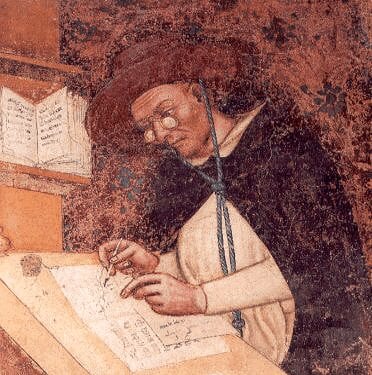
And one of them is wearing eyeglasses.
Not the earliest image of eyeglasses in the world — eyeglasses were invented somewhere around 1290 in northern Italy, and there are marginally earlier depictions — but the earliest known painted portrait of a human being wearing them. The friar in question is Cardinal Hugh of Saint-Cher, shown seated at his desk with a pair of rivet spectacles balanced on his nose, reading what appears to be a biblical commentary. Next to him, another friar uses a magnifying glass. These are, respectively, the first depictions of corrective lenses and of a magnifying glass in the history of European painting.
This would be remarkable if Tomaso da Modena were already famous. He is not, in the English-speaking world, remotely famous. In Italy he is respected; in the Veneto he is honored; in Treviso, where virtually his entire surviving work is located, he is the subject of genuine civic pride. In the United States, in the United Kingdom, in the broader English-language cultural conversation, he is essentially invisible. The art history surveys mention him briefly as a predecessor of the International Gothic style, attribute to him a modest technical competence, and move on to Giotto, whom he postdates, and to the Limbourg Brothers, whom he predates by half a century.
This is a significant misreading of what Tomaso da Modena accomplished, and Treviso is the place where the misreading can be corrected.
Who Was Tomaso da Modena?
He was born in Modena, in the Emilia-Romagna region of northern Italy, somewhere around 1325 or 1326 — the exact date is uncertain, as are most biographical details of his early life. His father, Barisino di Bartolommeo, was a painter of modest reputation, and it is reasonable to assume that Tomaso learned the craft in his father’s workshop before moving, sometime in the 1340s, to Treviso.
Why Treviso? The answer is almost certainly the Dominican order. The church of San Nicolò, begun in the late thirteenth century and still under active development through the fourteenth, was one of the major Dominican foundations in the Veneto, and the Dominicans were among the most significant artistic patrons of the period. The commission that would define Tomaso’s career — the thirty-seven portraits in the chapter house — came from the Dominican community of San Nicolò, and the subject matter was determined by the order’s intellectual self-image: these were portraits of the great scholars and theologians of Dominican history, men of learning depicted in the act of learning, in a room where the living friars would gather daily to conduct the business of their community.
The commission was completed in 1352. Tomaso was approximately twenty-six years old. What he produced was unlike anything that had been painted in northern Italy before it.
The Chapter House Frescoes: What Makes Them Revolutionary
To understand what Tomaso da Modena achieved in the chapter house of San Nicolò, it helps to understand what portraiture looked like in European painting in the decades immediately preceding 1352.
The short answer is: it barely existed as an independent category. The medieval tradition of depicting human figures was hierarchical and typological rather than individual: saints were identified by their attributes — the wheel of Saint Catherine, the keys of Saint Peter, the lion of Saint Mark — rather than by any attempt to capture individual appearance or psychology. The face was a symbol, not a window. The body was a vehicle for theological meaning, not a record of a particular person in a particular moment.
Giotto di Bondone, working in Padua and Florence in the early fourteenth century, had begun to introduce a new kind of psychological presence into religious painting: his figures in the Scrovegni Chapel in Padua, completed in 1305, have faces that express recognizable human emotions — grief, joy, surprise, love — with a directness that had no precedent in Western painting. But Giotto’s figures are still, at their core, participants in sacred narrative. They express emotion in the service of theological drama. They are not portraits.
What Tomaso da Modena painted in the chapter house of San Nicolò in 1352 was something categorically different: thirty-seven individual human beings, depicted not in the act of participating in sacred narrative but in the act of doing their daily intellectual work. Cardinal Hugh of Saint-Cher reads. Albert the Great writes. Thomas Aquinas thinks, his pen resting against his lip, his eyes focused on something slightly to the left of the manuscript in front of him — the specific gaze of someone whose mind has temporarily departed from the text and is working on a problem that the text raised. These are not symbols. They are people.
The technical means by which Tomaso achieves this individuation are worth examining, because they reveal a painter of considerable sophistication operating well ahead of his historical moment. Each figure is rendered in a different posture, with a different relationship to the desk and the manuscript and the light source. The hands — almost always the most revealing element in any portrait — are differentiated with a specificity that is startling in a fourteenth-century fresco: some figures grip their pens with the focused intensity of fast writers; others hold them loosely in the manner of someone pausing to think; still others have set them down entirely and are using their hands to hold open a manuscript or to rest their chin in thought.
The faces are the most remarkable achievement. In the tradition of medieval painting, faces were constructed from a limited repertoire of types — the bearded elder, the smooth-faced youth, the stern authority, the gentle contemplative. Tomaso’s faces deviate from this typology in ways that suggest direct observation of living human beings: the slightly asymmetrical features of one friar, the specific quality of aged skin in another, the particular set of the jaw in a third that conveys not a general human characteristic but the specific stubbornness of an individual who has argued his positions for fifty years and has not yet encountered an argument capable of moving him.
These are, in the fullest sense of the word, portraits. The fact that most of the subjects had been dead for a century or more when Tomaso painted them does not diminish this quality; it amplifies it. Tomaso was not painting from life. He was inventing a visual language capable of conveying individual human identity, and applying it retrospectively to figures known primarily through their written work. This is an act of extraordinary imaginative and technical ambition for a twenty-six-year-old painter working in 1352.
The Eyeglasses: A Small Detail and What It Means
The Cardinal Hugh of Saint-Cher fresco — the one with the eyeglasses — has attracted more attention from historians of science than from art historians, which is both understandable and slightly unfortunate, because the eyeglasses are interesting for reasons that go beyond the history of corrective lens technology.
Eyeglasses were a very new technology in 1352. They had been invented, probably in Pisa or Venice or somewhere in the northern Italian glass-working tradition, around 1290 — barely sixty years before Tomaso painted this fresco. They were luxury objects, available only to the wealthy and the learned, and they were associated specifically with the kind of intensive manuscript reading that defined Dominican intellectual life. By depicting Cardinal Hugh wearing them, Tomaso was making a specific argument about the cardinal’s identity: this is a man of such serious and sustained scholarly engagement that he has strained his eyes in the service of learning and now requires mechanical assistance to continue.
The magnifying glass in the adjacent fresco of Nicholas of Giovinazzo carries a similar weight of meaning. These are not incidental details; they are characterological statements, encoded in objects that a fourteenth-century audience would immediately recognize as markers of a specific kind of intellectual identity.
But there is something else worth noting. The fact that Tomaso painted these objects at all — that he chose to include, in a formal portrait cycle of Dominican scholars, the specific tools that those scholars used in their daily work — reflects a philosophical position about what portraiture is for. A portrait, in Tomaso’s understanding, is not simply a record of a face. It is a record of a life: the objects through which that life was conducted, the postures that sustained it, the specific quality of attention that it required. The eyeglasses are not a curiosity. They are a theory of the portrait.
The Rest of the San Nicolò Complex
The chapter house frescoes are the reason to make a specific pilgrimage to the San Nicolò complex, but they are not the only reason to be there.
The church itself is one of the great Gothic buildings of the Veneto, and it is almost systematically undervisited by the international tourists who spend their hours in Venice without knowing that forty minutes north there is a church that rivals anything the lagoon city contains in terms of scale, architectural ambition, and fresco decoration. San Nicolò was begun in the late thirteenth century and substantially completed through the fourteenth; its nave is 93 meters long, its vaulted ceiling rises to 25 meters at the crossing, and its brick construction — the characteristic material of the Veneto plain, where stone is scarce and the clay deposits of the river systems provide an almost unlimited supply of excellent brick — produces the particular warm redness that distinguishes northern Italian Gothic from its French and English counterparts.
The frescoed columns inside the church are Tomaso da Modena’s work as well: a series of figures of saints painted directly onto the great cylindrical pillars of the nave, each one in a niche-like architectural setting that creates the illusion of three-dimensional sculpture painted in two dimensions. Giorgio Vasari, the sixteenth-century art historian and painter whose Lives of the Artists remains the foundational text of Italian art historiography, specifically mentioned Tomaso’s work at San Nicolò in terms that indicate genuine admiration — a significant endorsement from a writer who was not in the habit of distributing praise indiscriminately to fourteenth-century painters outside the Tuscan tradition.
The tomb of Cardinal Gian Gaetano Orsini in the right transept is among the finest examples of Gothic funerary sculpture in the Veneto. The stained glass of the apse windows, restored in the twentieth century but substantially original in design, produces a quality of colored light in the late afternoon that makes the interior feel genuinely different from any other church in the region.
The Museo Civico: The Rest of Tomaso’s Treviso
The largest concentration of Tomaso da Modena’s surviving panel paintings is in the Museo Civico di Treviso, housed in the former convent of Santa Caterina — a different convent from the San Nicolò complex, located on the other side of the historic center, accessible on foot in ten minutes from Piazza dei Signori.
The museum’s Tomaso holdings include the remarkable polyptych of the Dominican Saints, a multi-panel altarpiece that demonstrates the full range of the painter’s technical abilities in a format different from the chapter house frescoes: smaller scale, more intensive detail, the luminous surface quality achievable in egg tempera on panel that fresco, by its nature, cannot produce. The figures here have the same psychological presence as the chapter house portraits, concentrated into smaller fields and therefore, in some ways, even more intense.
The museum also contains, in a separate hall, Tomaso da Modena’s most theatrically ambitious work: the fresco cycle of the Life of Saint Ursula, painted for the church of Santa Margherita in the 1350s and detached from its original location in the nineteenth century. The Ursula cycle is Tomaso operating at narrative scale — a sequence of episodes from the legend of the British princess who led eleven thousand virgin martyrs on a pilgrimage to Rome and was killed by Huns at Cologne on the return journey — and it demonstrates a command of pictorial storytelling, of the management of multiple figures in complex spatial arrangements, that places him without question in the first rank of European painters of his generation.
The Ursula cycle has been compared to the great narrative fresco cycles of Giotto in Padua and Assisi, and the comparison is not absurd. It is, in many respects, more spatially sophisticated than Giotto’s work: the architectural settings are more convincingly rendered, the crowd scenes are more differentiated, and the individual figures — particularly in the scenes of embarkation and arrival at harbor, where Tomaso had to manage the visual complexity of ships, water, crowds, and ceremonial architecture simultaneously — are handled with a compositional confidence that seems, on the evidence of the surviving work, to have developed very rapidly between the chapter house commission of 1352 and the Santa Margherita cycle of the mid-1350s.
The Castel Buonconsiglio Connection
Tomaso da Modena’s influence extended well beyond Treviso during his lifetime, and one of the most significant pieces of evidence for his broader reputation is the commission he received, sometime in the 1360s, from the Prince-Bishops of Trento — the powerful ecclesiastical rulers of the Trentino region to the north — to paint a series of panels for the Castel Buonconsiglio, the great episcopal palace overlooking the city of Trento.
The panels that survive from this commission — a series of half-length figures of saints, painted with the same psychological intensity and technical precision that characterize the Treviso work — confirm that Tomaso’s reputation had spread well beyond the Venetian terraferma by the decade after the chapter house frescoes. The Prince-Bishops were sophisticated patrons with access to the best artists of the period; their decision to commission Tomaso da Modena reflects a judgment about his standing in the hierarchy of contemporary painters that the subsequent art-historical tradition has failed to fully endorse.
There is also a documented connection, through the Bohemian court of Emperor Charles IV, to the broader Central European Gothic tradition: Tomaso’s work appears to have been known and influential in Prague in the 1360s, and the specific quality of psychological individualization that distinguishes the chapter house frescoes can be traced forward through the Bohemian painting of the later fourteenth century in ways that suggest a direct line of influence from Treviso to Prague. This is speculative in its precise mechanisms but well-established in its general outlines by the scholarship of the past thirty years.
Why This Matters for How We Think About Treviso
There is a version of Treviso that presents itself as Venice’s charming, affordable alternative: the canals without the crowds, the palazzi without the queues, the aperitivo without the markup. This version is not wrong, but it is incomplete, and it is incomplete in a way that undersells the city’s actual historical weight.
Treviso was not always the quieter, smaller version of a more important place. In the fourteenth century, when Tomaso da Modena was working here, Treviso was a significant city in its own right — a city with major religious institutions, a sophisticated intellectual and ecclesiastical culture, and artistic patronage of sufficient quality to attract and sustain a painter of the first rank. The chapter house of San Nicolò is not a provincial achievement. It is a metropolitan one, produced in a city that understood what it was commissioning and had the cultural resources to sustain the painter who produced it.
When I take visitors into the chapter house — through the door that requires ringing a bell, past the custodian who knows these paintings better than anyone — I am not showing them a curiosity or a footnote. I am showing them one of the significant achievements of fourteenth-century European painting, produced in a room that most of the world does not know exists, in a city that the world has decided is primarily valuable as an alternative to somewhere else.
Tomaso da Modena painted thirty-seven portraits of Dominican scholars in 1352 and in doing so helped invent the portrait as a form. One of them is wearing eyeglasses. The room is available to visit on most weekdays. The custodian will let you in if you ring the bell and explain yourself.
Ring the bell.
📩 My private tours of Treviso include a full visit to the San Nicolò chapter house and the Tomaso da Modena frescoes, with time spent with the custodian who knows these paintings and their history in depth. I also guide the Museo Civico Santa Caterina collections, including the Ursula cycle, in the context of fourteenth-century Veneto painting and what it tells us about the city that produced it. For visitors who want to understand Treviso as a place with its own historical weight — not just as Venice’s quieter neighbor — this is the tour I would recommend. Get in touch at tourleadertreviso.com.
Frequently Asked Questions
How do I access the chapter house frescoes at San Nicolò?
The chapter house is inside the Seminary building attached to the church of San Nicolò, entered through a separate door on the side of the complex rather than through the church itself. You ring the bell and a custodian admits you; there is a small entry fee, typically €3–5. The church itself is free to enter during opening hours. The chapter house is generally accessible on weekday mornings and early afternoons; hours can vary, and I recommend checking current access arrangements before planning your visit, or including the visit as part of a guided tour where access is confirmed in advance. The combination of the church, the chapter house, and the Museo Civico Santa Caterina constitutes a full half-day itinerary for anyone seriously interested in Trevisan art history.
Is Tomaso da Modena’s work discussed in mainstream art history?
He appears in survey histories of Italian art and in specialized studies of the International Gothic style, but he has not received the sustained critical and popular attention that his work warrants, particularly in the English-speaking world. The most thorough English-language treatment of his work appears in academic monographs on fourteenth-century Italian painting rather than in the popular art history literature. This is partly a function of geography — most of his surviving work is in Treviso, which has not historically been on the primary international art tourism circuit — and partly a function of the general underrepresentation of northern Italian painting of the Trecento in the English-language art historical canon, which has tended to focus on the Tuscan tradition at the expense of the Venetian and Paduan schools. There is a reasonable argument to be made that Tomaso da Modena is the most significant European painter of the mid-fourteenth century whose work has not yet received commensurate critical attention in English.
What else should I see in Treviso if I am interested in medieval and Renaissance art?
The Cappella Malchiostro inside the Cathedral of San Pietro contains Titian’s Annunciation of 1520 — recently restored, signed and dated, and among the most important works of Titian’s early career. The Loggia dei Cavalieri on Piazza dei Signori is one of the best-preserved examples of Romanesque civic architecture in the Veneto, built in the twelfth century as a sheltered gathering space for the city’s nobility and decorated with frescoes that are among the earliest surviving examples of secular painting in northern Italy. The Museo Civico Santa Caterina holds not only the Tomaso da Modena panels but a collection of Veneto painting spanning the thirteenth through eighteenth centuries that is, taken as a whole, one of the most coherent and historically legible regional collections in Italy. A full day spent moving between these sites — San Nicolò in the morning, the Cathedral at midday, the museum in the afternoon — constitutes one of the most rewarding art historical itineraries available in any Italian city of Treviso’s size. Read more about how to structure your time in Treviso.
Igor Scomparin is a licensed Tour Guide and Tour Leader for the Veneto Region, certified Travel Agency Director, and founder of tourleadertreviso.com. He has been featured in Rick Steves’ travel guides to Italy and Europe since 2008.