Vigneti Aperti: How to Visit the Open Wineries of the Veneto This Spring
I now have everything I need. The 2026 edition of Vigneti Aperti is confirmed running March through October; the Primavera del Prosecco Superiore 2026 runs March 13 through June 14 across 17 Mostre del Vino on the UNESCO hills. Let me write the article now.
Vigneti Aperti: How to Visit the Open Wineries of the Veneto This Spring
There is a particular moment in a winery visit that no amount of reading about wine can prepare you for, and that no wine shop or restaurant can replicate, and that the Veneto’s spring open-winery season exists specifically to provide.
It happens when the person pouring your glass is the person who grew the grapes, made the wine, and is now standing in the vineyard they have been tending since before you were born — or that their parents were tending, or their grandparents — and explaining, with the specific authority of someone who has never needed to learn this from a book, exactly why the Prosecco in your glass tastes the way it does and not some other way. Why this slope and not the one across the valley. Why this vintage and not the last. Why the traditional method they still use here, in this specific part of the Conegliano Valdobbiadene hills, produces a wine with a quality that the larger industrial producers on the plain have never quite managed to replicate, despite having far more equipment and far larger budgets.
That moment — the winemaker in their own vineyard, the glass in your hand, the hills around you, the explanation that connects all three — is what visiting the open wineries of the Veneto in spring is actually about. The wine is excellent. The landscape is extraordinary. But the access is what is irreplaceable.
I am Igor Scomparin, a licensed Tour Guide and Tour Leader for the Veneto Region. I have been taking guests into the vineyards north of Treviso for twenty years, and the spring season — from March through June, when the vines are waking up, the new growth is just appearing on the old wood, and the wineries of the province open their gates for the most sustained programme of enotourism events in the Italian calendar — remains, year after year, one of the experiences I am most committed to making available to visitors who arrive in this territory having heard about Prosecco but not yet understanding what it actually is or where it actually comes from.
This article explains the two major spring programmes that make this possible, how they work, what they offer, and how to build a visit around them from a base in Treviso or the surrounding province.
Two Programmes, One Territory
The spring open-winery season in the Veneto is organized through two distinct but overlapping initiatives, each with its own logic and its own character. Understanding the difference between them helps you choose the right approach for your visit.
Vigneti Aperti — Open Vineyards — is the national programme organized by the Movimento Turismo del Vino, the non-profit association of wine producers founded in 1993 with the specific purpose of encouraging direct visits to wine estates and deepening the public’s relationship with the people and places that produce Italian wine. The programme runs from March through October, with participating wineries across every Italian region opening their gates on designated weekends throughout the season for a programme that goes well beyond tastings: guided vineyard walks, bicycle routes through the vine landscape, picnics between the rows, cooking classes and dinners with the winemaker, artistic workshops, family activities, and the kind of extended, unhurried contact with a wine estate that the standard cellar tour does not provide.
In the Veneto, the Movimento Turismo del Vino’s regional branch — MTV Veneto — coordinates participation across the province, with member wineries in the Conegliano Valdobbiadene DOCG zone, the Valpolicella, the Piave DOC corridor, and a number of smaller appellations. The Treviso province accounts for a significant share of MTV Veneto’s member estates, given that the Conegliano Valdobbiadene hills — the production zone of Prosecco Superiore DOCG — sit entirely within the province of Treviso. Each participating winery designs its own programme for each open weekend; the range of activities and price points varies considerably, and advance booking is required or strongly recommended for the more structured experiences.
Primavera del Prosecco Superiore — the Spring of the Prosecco Superiore — is a parallel programme specific to the Conegliano Valdobbiadene territory, organized by a committee representing the Pro Loco associations, the municipalities of the production zone, the Treviso Chamber of Commerce, and the Consorzio di Tutela del Conegliano Valdobbiadene Prosecco Superiore DOCG. It is, in essence, the spring event programme of the Prosecco Superiore UNESCO hills: seventeen Mostre del Vino — Wine Exhibitions — running in sequence across fifteen municipalities from mid-March through mid-June, each organized by the local Pro Loco association, each presenting the wines of its specific sub-zone alongside food, music, guided hikes, and the kind of localized cultural programme that the national Vigneti Aperti initiative cannot replicate at this level of territorial specificity.
The 2026 edition of the Primavera del Prosecco Superiore runs from March 13 to June 14, with seventeen individual Mostre opening in sequence across the hills — from the Mostra del Cartizze in Santo Stefano di Valdobbiadene in mid-March through the Mostra of Vittorio Veneto and the closing events in Soligo in June. Each Mostra is a standalone multi-week event: a dedicated venue, typically in a converted civic building or agricultural space, where the local wines are presented for tasting by qualified sommeliers alongside food from the local culinary tradition and a programme of evening dinners, vineyard walks, and cultural events running through the Mostra’s duration.
The two programmes complement each other rather than competing. Vigneti Aperti gives you direct access to individual wine estates — the winery itself, the cellar, the producer — as an intimate, small-group experience. The Primavera del Prosecco gives you the breadth of the appellation’s wine culture across seventeen sub-zones and the specific social texture of events organized by and for the communities that produce the wine. The ideal spring visit to the Prosecco hills combines both.
What the Spring Vines Look Like — and Why It Matters
Before describing the specific events and experiences, I want to make the case for why visiting the Veneto’s wine territory in spring rather than autumn is the right choice for most visitors, because the conventional assumption — harvest equals wine equals the right time to visit — is not correct.
The spring vineyard is a different landscape from the autumn vineyard, and it is, in many respects, a more interesting one. In October, when the harvest is underway, the vines are at the end of their annual cycle: the grapes are gone or going, the leaves are turning, the equipment is moving through the rows, and the energy of the estate is concentrated entirely on the harvest itself. It is spectacular in its own way, but it is a landscape at its conclusion.
In spring — March through May — the vineyard is at its beginning, and the specific stage of the annual cycle visible in the Conegliano Valdobbiadene hills during the Primavera del Prosecco is one of the most important and the least observed. The vines have been pruned through the winter; the old canes cut back to the living wood, the decisions about this year’s production made in February and March by the pruner who knows each vine individually. From late March, the new growth begins: the first buds breaking from the wood, then the shoot growth extending, the first leaves unfolding in the pale green that is the most vivid green in the annual colour palette of this landscape.
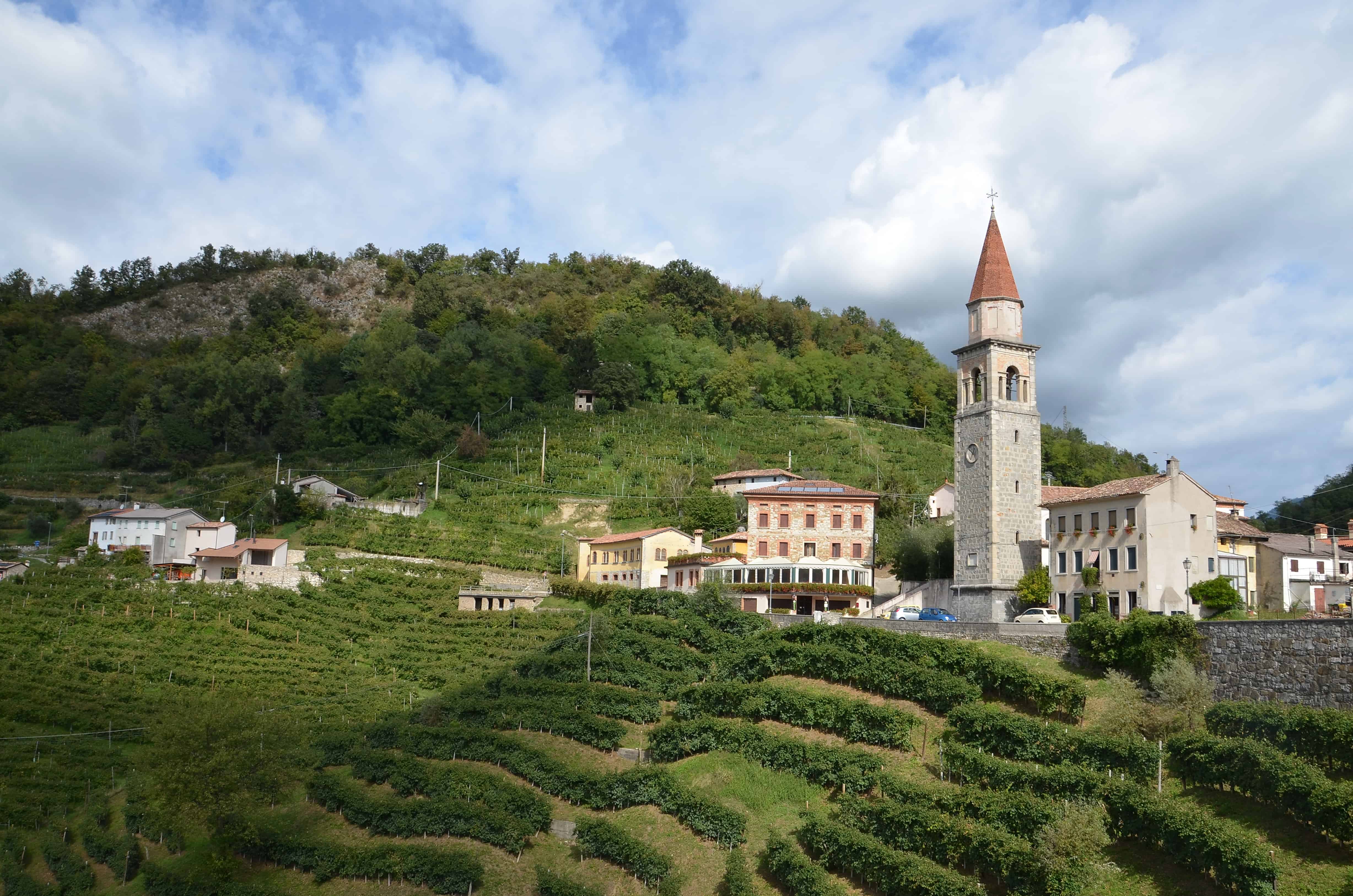
What the spring also reveals, in a way that the fully leafed summer vineyard does not, is the structure of the land itself. The UNESCO designation of the Conegliano Valdobbiadene hills — received in 2019 as a landscape of Outstanding Universal Value — is based partly on the specific topography of this territory: the steep slopes, the ancient terracing, the pattern of small individually owned parcels that gives the hillsides their characteristic striped appearance when seen from the valley. In spring, before the vegetation fills in, this structure is at its most legible: the terraces visible, the individual vine rows distinct, the interplay of woodland and vineyard and the villages perched on the ridge that makes this one of the most beautiful agricultural landscapes in Europe genuinely clear in a way that summer’s green density softens.
And the Prosecco in spring — the wine made from the previous October’s harvest, now through its secondary fermentation in the Charmat method, beginning to be released for the season — is at the specific stage of its development that the Mostre del Vino were originally designed to present: fresh, just ready, carrying the particular character of the vintage that will develop and then fade over the following months.
The Mostre del Vino: What to Expect
The Mostre del Vino that form the spine of the Primavera del Prosecco Superiore have a history longer than the coordinating programme that now organizes them. The oldest of the individual Mostre have been running for over sixty years, originating in the tradition of local producers presenting their new wine to the community at the arrival of spring — outside church doors after Sunday Mass, at village gathering points, in the civic spaces of the hill towns that dot the Prosecco zone from Valdobbiadene to Vittorio Veneto.
Today each Mostra is a multi-week event occupying a dedicated venue — often a restored agricultural building, a Pro Loco headquarters, or a civic hall fitted out with tasting benches and a kitchen for the season. The wine service at each Mostra is professional: qualified sommeliers from the Italian Sommelier Association rotate through the event to ensure consistent presentation and accurate description of the wines being poured. This is not a festival where wine is served from unmarked bottles by volunteers with no particular training. The Mostre take the quality of their service seriously, which is why they have maintained their reputation across sixty years of operation.
What you will find at a typical Mostra:
The wine selection at each Mostra represents the production of its specific sub-zone. The Mostra of Santo Stefano di Valdobbiadene — the first Mostra of the season, traditionally opening in mid-March — concentrates on the Cartizze, the prestigious single-vineyard grand cru of the Valdobbiadene DOCG, a ten-hectare parcel on a steep south-facing slope that produces the most complex and structured expression of the Glera grape in the appellation. The Mostra of Fregona presents the Torchiato di Fregona, a rare amber-gold dessert wine made from partially dried Verdiso and Boschera grapes — a wine so obscure and so specific to a handful of villages in the northern Treviso hills that most wine professionals outside Italy have never encountered it. The Mostra of Miane presents the full range of the appellation alongside the Verdiso IGT, the local white variety that predates Prosecco’s dominance and that is undergoing a quiet revival among producers interested in the territory’s vinous identity before the Glera monoculture took hold.
The food at each Mostra is the food of the local tradition: soups made from the legumes and vegetables of the hill agriculture, cured meats from the farms of the Alta Marca, cheeses from the dairy operations that still function in the villages of the Fregona and Tarzo zone, the pasta and risotto of the Trevisan table presented in versions specific to each locality. A Mostra evening — arriving at seven, finding a table, ordering a glass of the local Prosecco and a plate of the house food, watching the room fill with the village’s own people who have been coming here since childhood — is a specific quality of experience that exists in very few other contexts in Italian wine tourism.
The events calendar that surrounds each Mostra’s core tasting programme extends to guided vineyard walks (the Rive trails — the UNESCO-designated routes between the individual village sub-zones — are walkable throughout the season), cycling routes through the hills on the mapped network of roads and paths that connects the Mostre to each other, cultural evenings with local historians and winemakers discussing the appellation’s history and evolution, and the annual award recognizing the most sustainable producer of the year — a competition that reflects the territory’s increasing investment in environmental responsibility.
Vigneti Aperti at Individual Estates: A Different Scale
Alongside the Mostre, the Vigneti Aperti programme at individual estates offers a more intimate and more variable experience. Where the Mostre present the appellation collectively and in a social context, the estate open-weekend puts you directly in the hands of a single producer and gives you access to their specific story: their vineyard parcels, their production choices, their cellar, their family history with this land.
The activities offered across the MTV Veneto estates during spring Vigneti Aperti weekends span a wide range. At the simpler end: an open cellar with self-guided tasting and the option to buy. At the more structured end: a guided tour of the vineyard with the winemaker explaining the seasonal stage of the vines, the pruning decisions made this winter, the specific characteristics of each parcel; a cellar tour explaining the Charmat method (for Prosecco estates) or the traditional method (for estates producing spumante classico); a guided tasting of four to six wines with food pairing; and a lunch or dinner with the producer’s family, served in the estate’s farmhouse kitchen, cooked from produce grown on the estate.
The price range across these experiences in recent seasons has run from a €5–6 welcome glass at simple open-cellar events to €30–45 for the full guided tour, tasting, and lunch combination. Advance booking is essential for anything involving lunch or a structured guided experience; the more popular estates in the UNESCO zone fill their Vigneti Aperti slots weeks in advance.
The estate experiences that reward most from a visitor’s perspective are not necessarily the largest or most famous producers. The small family estates — the ones with five to ten hectares, producing Prosecco Superiore in volumes that never reach export markets, known primarily to the restaurants and private clients of the Treviso province — offer the kind of direct access to the human story behind the wine that the larger commercial operations cannot replicate. These are the estates where the person leading your vineyard walk is the person who pruned the vines in January and who will be picking in October: someone whose relationship with this land is not professional but existential, and whose explanation of why they still farm it the way their grandparents did contains an argument about value that no marketing document captures.
Finding these estates is exactly the kind of local knowledge that benefits from guidance. I identify them for guests as part of the provincial itineraries I organize, and the visits I arrange through Vigneti Aperti weekends are consistently among the experiences my guests cite when they write to tell me what they remember most from a visit to the Treviso province.
The Territory: What You Are Moving Through
The Conegliano Valdobbiadene hills occupy a strip of terrain approximately forty kilometres long and between five and fifteen kilometres wide, running east-west across the northern edge of the Treviso province between the towns of Conegliano in the east and Valdobbiadene in the west. This strip — which received UNESCO World Heritage designation in 2019 as a landscape of Outstanding Universal Value — is defined by its topography: a sequence of steep, south-facing slopes rising from the flat Venetian plain to elevations between 100 and 500 metres, covered in a mosaic of vineyards, woodland, orchards, and villages that has been shaped by eight centuries of continuous human management.
The UNESCO designation specifically recognizes the viticultural landscape — the combination of the natural topography and the human intervention of terracing, planting, and cultivation that has transformed steep and difficult terrain into one of the most productive and celebrated wine zones in Italy. The ancient terraces — some of them built in the medieval period or earlier — are maintained by hand on slopes too steep for mechanical equipment, by families who have been doing this work for generations and who continue to do it because the wine produced from these specific parcels justifies the extraordinary labour cost.
Driving through this territory in spring — from Treviso northward along the Strada del Prosecco toward Conegliano, then west through the hills toward Valdobbiadene, the road rising and falling through the villages of the appellation — is an experience in visual beauty that I never fully adjust to, despite twenty years of it. The hills change character every few kilometres: softer and rounder near Conegliano, steeper and more dramatic near Valdobbiadene, the Dolomites visible to the north on clear days, the flat plain of the Venetian lagoon basin extending south toward the sea. The villages — Santo Stefano di Valdobbiadene, Col San Martino, Miane, Refrontolo, Guia, Cison di Valmarino — are small, unhurried, organized around the church and the Pro Loco and the Mostra del Vino that runs for three weeks every spring and has been the social event of the year for longer than anyone currently alive can remember.
This is not, it should be said, a landscape that presents itself immediately as a tourist destination. There are no grand hotels. There are few restaurants with international recognition, though there are excellent osterie and agriturismi of the kind that rewards local knowledge. There is nothing that announces itself as spectacular in the way that Tuscany’s Chianti hills or the Amalfi Coast announce themselves. What is here is quieter and, I would argue, more honest: a working agricultural landscape that happens to be extraordinarily beautiful, inhabited by people who are still primarily engaged in making wine rather than in presenting the experience of wine to visitors.
The UNESCO designation is changing this gradually. But the Conegliano Valdobbiadene hills in spring 2026 remain substantially what they have always been — a wine landscape that you have to know how to enter, and that rewards entry generously.
Practical Planning: How to Build Your Visit
A visit to the Veneto spring wine events from a Treviso base is straightforward to organize but requires some advance planning, particularly for the individual estate experiences within Vigneti Aperti. Here is the framework I use when building this kind of day for guests.
Timing. The Primavera del Prosecco Superiore 2026 runs March 13 through June 14. The Mostre open in sequence beginning with Santo Stefano di Valdobbiadene in mid-March; by April, four to six Mostre are typically running simultaneously across the hills. The densest period — the most Mostre active at once, the most producer events open — is April through mid-May, which is also when the landscape is at its most vivid with spring growth. This period aligns with the asparagus season in the Piave plain, which means a day that begins at the Treviso Saturday market, moves to the hills for a Mostra or a producer visit, and ends with asparagus at an osteria in the Prosecco zone is a coherent experience of this territory at its seasonal best.
Transport. The Prosecco hills are not accessible by public transport in any form that allows a useful visit. A car is essential, which means — critically for a wine visit — a designated non-drinking driver or an arrangement with a private transfer operator. This is not a detail to underestimate: the roads through the hills are narrow, winding, and policed, and the new Italian highway code has significantly tightened enforcement on drink-driving in ways that make the risk calculation straightforward. I organize private guided visits with a driver for exactly this reason, which solves the logistics and adds the interpretive layer that makes the difference between seeing the landscape and understanding it.
Booking individual estate visits. For Vigneti Aperti at individual estates, consult the MTV Veneto website (mtvveneto.it) and the national Movimento Turismo del Vino site (movimentoturismovino.it) for the participating estates and their spring programmes. Each estate lists its open weekends, activities, prices, and booking requirements. For the most structured experiences — vineyard walks, guided tastings, lunches with the producer — book at least two to three weeks in advance. The estates that offer these experiences have limited capacity by design, and the best ones fill early.
Attending a Mostra. The Mostre del Vino do not generally require advance booking for entry; you arrive, pay the entrance fee (typically in the range of €5–10 which includes a tasting glass), and taste at your own pace. The evening programmes — dinners, guided walks, special events — do require booking and fill quickly. Check the programme on the Primavera del Prosecco website (primaveradelprosecco.it) in advance and identify the specific events you want to attend.
Combining events. A day combining a morning Vigneti Aperti visit at a small producer with an afternoon at the relevant Mostra del Vino in the same sub-zone gives you both the intimate estate experience and the community context, and makes the transition between them instructive: you have just seen a specific producer’s cellar and vineyard, and you can now taste how their wine compares to others from the same hills presented under the same conditions.
The Strada del Prosecco. The Strada del Prosecco — the world’s first designated wine road, established in 1966, running from Conegliano to Valdobbiadene along the ridge of the UNESCO hills — is the route that connects the Mostre to each other and that, in spring, is at its most beautiful. Driving it end to end takes approximately two hours with stops; as the organizing axis of a full-day wine itinerary it gives the day a narrative coherence that a random sequence of estate visits does not.
The Wines Beyond Prosecco
One of the things I most want visitors to the Prosecco hills to discover during the spring events is that the territory produces wines other than Prosecco, and that some of these other wines are among the most interesting and least exported in northeast Italy.
The Verdiso IGT is the indigenous white variety that preceded Prosecco’s commercial dominance in these hills, producing a naturally high-acid wine with green apple and citrus character that is served as an aperitivo in the osterie of the Alta Marca Trevigiana with the same matter-of-fact regularity that Prosecco is served everywhere else. A small number of producers are reviving serious Verdiso production, and the Mostra of Combai — specifically dedicated to Verdiso, with the event name È Verdiso — is where to find them in concentrated form in early May.
The Torchiato di Fregona is a passito wine made from Verdiso, Boschera, and Incrocio Manzoni grapes, dried on traditional wooden frames — the torcio that gives the wine its name — through the winter before pressing, producing a deep golden-amber wine of moderate sweetness and considerable complexity, drinking best with aged cheeses or the dried fruit and nut preparations of the local cooking tradition. It is produced by fewer than a dozen estates in the villages around Fregona and Tarzo, and finding it outside this specific zone requires effort. The Mostra di Fregona, running in May, presents it alongside the Colli di Conegliano DOCG whites and reds — another set of wines largely unknown outside the province, made from native varieties on the steeper slopes around Vittorio Veneto.
The Raboso del Piave — produced in the Piave DOC zone to the southeast of the Prosecco hills, on the flat alluvial plain between Treviso and the Adriatic — deserves a mention in any serious account of the Veneto’s spring wine culture, even though it is not part of the Primavera del Prosecco programme. Raboso is the red grape indigenous to the Piave corridor: tannic, high-acid, structured to the point of severity in its youth, requiring significant aging before its character resolves into the complex, earthy, slightly austere wine that the osterie of the Treviso province pour alongside braised meats and polenta in winter and spring. It is the Sunday lunch wine of this territory in a way that no imported variety has ever managed to replicate, and it is virtually unknown internationally, which is a situation that rewards the visitor who takes the trouble to find it.
A Note on Drinking Responsibly in this Territory
Italy’s revised highway code, introduced in recent years and increasingly enforced across the Veneto, establishes a legal blood alcohol limit of 0.5g/L for drivers — lower than in many American states — with zero tolerance (0.0g/L) for drivers under 21 or with less than three years’ driving experience. Enforcement has increased significantly in the Treviso province, particularly on the roads through the wine hills on weekend evenings.
This is not a limitation on enjoying the wine events of the Primavera del Prosecco or Vigneti Aperti. It is, rather, an argument for planning the transportation dimension of a wine day correctly from the start. Options include: a private transfer with a driver (the cleanest solution, and the one I organize for guests because it also adds the interpretive dimension of someone who knows the territory); a designated non-drinking driver within your group; an overnight stay in one of the agriturismi or small hotels within the Prosecco zone itself, eliminating the return journey entirely; or a structured guided day that handles transportation as part of the service.
The Mostre themselves are, by design, experiences of moderation: tasting-glass portions, good food alongside the wine, a long afternoon of eating and drinking together at a pace that bears no resemblance to the consumption model of a drinks festival. The Movimento Turismo del Vino explicitly frames responsible drinking as a core value of the Vigneti Aperti initiative — the winemakers who participate in the programme are, in my experience, the first to moderate the quantities they pour and to tell you about the spring water from the hillside fountain behind the cellar.
📩 The spring wine events of the Treviso province — Vigneti Aperti at the individual estates, the Mostre del Vino of the Primavera del Prosecco Superiore, the Verdiso and Torchiato producers in the Alta Marca — are among the experiences I most enjoy guiding, because they give direct access to the human stories behind wines that most of the world drinks without knowing where they come from. I organize private guided days in the Prosecco hills throughout the spring season, with transport, interpretation, and the producer access that comes from twenty years of working in this territory. Get in touch to plan your visit.
Frequently Asked Questions
What is the difference between Vigneti Aperti and Cantine Aperte, and which one should I attend?
Vigneti Aperti is the spring and summer programme running from March through October, organized around the theme of the living vineyard and outdoor experience — vineyard walks, cycling routes, picnics between the rows, and the direct encounter with the land in its active growing season. Cantine Aperte — Open Cellars — is the single flagship weekend event of the Movimento Turismo del Vino calendar, held on the last Sunday of May (and increasingly on the Saturday as well), when all MTV member estates across Italy open simultaneously for a concentrated national wine-tourism event. Both programmes use the same network of member estates; the difference is that Vigneti Aperti is a distributed season-long invitation while Cantine Aperte is a concentrated single-weekend event with a national profile. For a visitor planning specifically around a wine-tourism experience, either is appropriate; the Cantine Aperte weekend in late May, when the Prosecco hills are at their most beautiful, the asparagus season is in its final weeks, and the entire wine community of the Veneto is simultaneously open for visitors, is the single best wine day of the spring calendar if you can time your visit to coincide with it. Check movimentoturismovino.it and mtvveneto.it for the specific 2026 date.
Do I need to speak Italian to enjoy the Mostre del Vino or the individual estate visits?
For the Mostre del Vino, basic functional Italian is helpful but not essential — the wine service at each Mostra is organized professionally, and the wines themselves communicate without language. A few words of Italian, a willingness to point at the menu, and the general demeanor of someone who is genuinely interested in what they are being shown will carry you through a Mostra visit without difficulty. For individual estate visits within Vigneti Aperti, particularly the more intimate family-estate experiences, the language question is more relevant: many of the small producers in the Prosecco hills have limited English, and the depth of the experience depends partly on the depth of the conversation. This is one of the practical arguments for going with a guide who can facilitate the exchange: not translating in the literal sense but creating the conditions in which the producer and the visitor can actually communicate, which is the whole point of the visit. I accompany my guests into these visits precisely because the difference between a tasting with explanation and a tasting without it is the difference between drinking something and understanding it.
Is the Prosecco Superiore DOCG produced in these hills genuinely different from the Prosecco DOC sold in supermarkets worldwide?
Yes, substantially, and the spring events are exactly the right context in which to understand why. Prosecco DOC is produced across a large zone covering nine provinces of northeast Italy, under relatively permissive production rules, at yields that prioritize volume. Prosecco Superiore DOCG — specifically the Conegliano Valdobbiadene Prosecco Superiore DOCG and the Asolo Prosecco Superiore DOCG — is produced in dramatically smaller and more geographically specific zones, on terrain that by its steepness and difficulty precludes mechanical harvesting, under stricter controls on yield and production method, by producers who are frequently working parcels that have been in their families for generations. The result is a wine of greater complexity, more distinct terroir character, and considerably more personality than the mass-market Prosecco DOC. Standing in the vineyard that produced the wine in your glass, watching the winemaker describe the specific slope angle and soil composition and drainage pattern that gives this parcel its character, and tasting the result — that is the experience that makes the distinction between Prosecco DOC and Prosecco Superiore DOCG not an abstraction but a lived reality. The Mostre and the Vigneti Aperti estate visits exist precisely to provide this experience.
Igor Scomparin is a licensed Tour Guide and Tour Leader for the Veneto Region, certified Travel Agency Director, and founder of tourleadertreviso.com. He has been featured in Rick Steves’ travel guides to Italy and Europe since 2008.