Vittorio Veneto in March: History, Wine and the Battle That Changed Italy
Here is the full article, clean prose, no source references:
Vittorio Veneto in March: History, Wine and the Battle That Changed Italy
There is a town about forty kilometres north of Treviso where two separate medieval villages face each other across a valley, where the hills are covered in Prosecco vines that produce some of the finest wine in the denomination, and where a battle was fought in the autumn of 1918 that ended a centuries-old empire, reshaped the map of central Europe, and contributed directly to the end of the First World War. Most Americans who fly into Treviso Airport and head south toward Venice drive past the exit for this town without stopping.
I want to change that. The town is Vittorio Veneto, and in March it is exactly the kind of place that rewards a slow day — history in the morning, wine in the afternoon, the hills at whatever pace suits you.
I am Igor Scomparin. I have held an official Tour Guide License for the Veneto region since 2007, and I have been bringing guests to Vittorio Veneto as part of my tours of the Treviso province for nearly two decades. I consider it one of the most underestimated destinations in northeastern Italy — a place where the weight of twentieth-century history sits alongside one of the world’s great wine landscapes, and where the combination of the two produces a day that you genuinely could not have anywhere else.
Two Cities in One
Vittorio Veneto is not, strictly speaking, a single historic centre. It is two medieval towns that grew up separately and were unified into one city in the nineteenth century — each with its own character, its own piazza, its own architectural identity.
Ceneda, in the lower part of the valley, was the episcopal seat — the city of bishops and religious authority. It has a different feel from its neighbour: more civic, more administrative, the kind of town square that was built for pronouncements and processions rather than commerce.
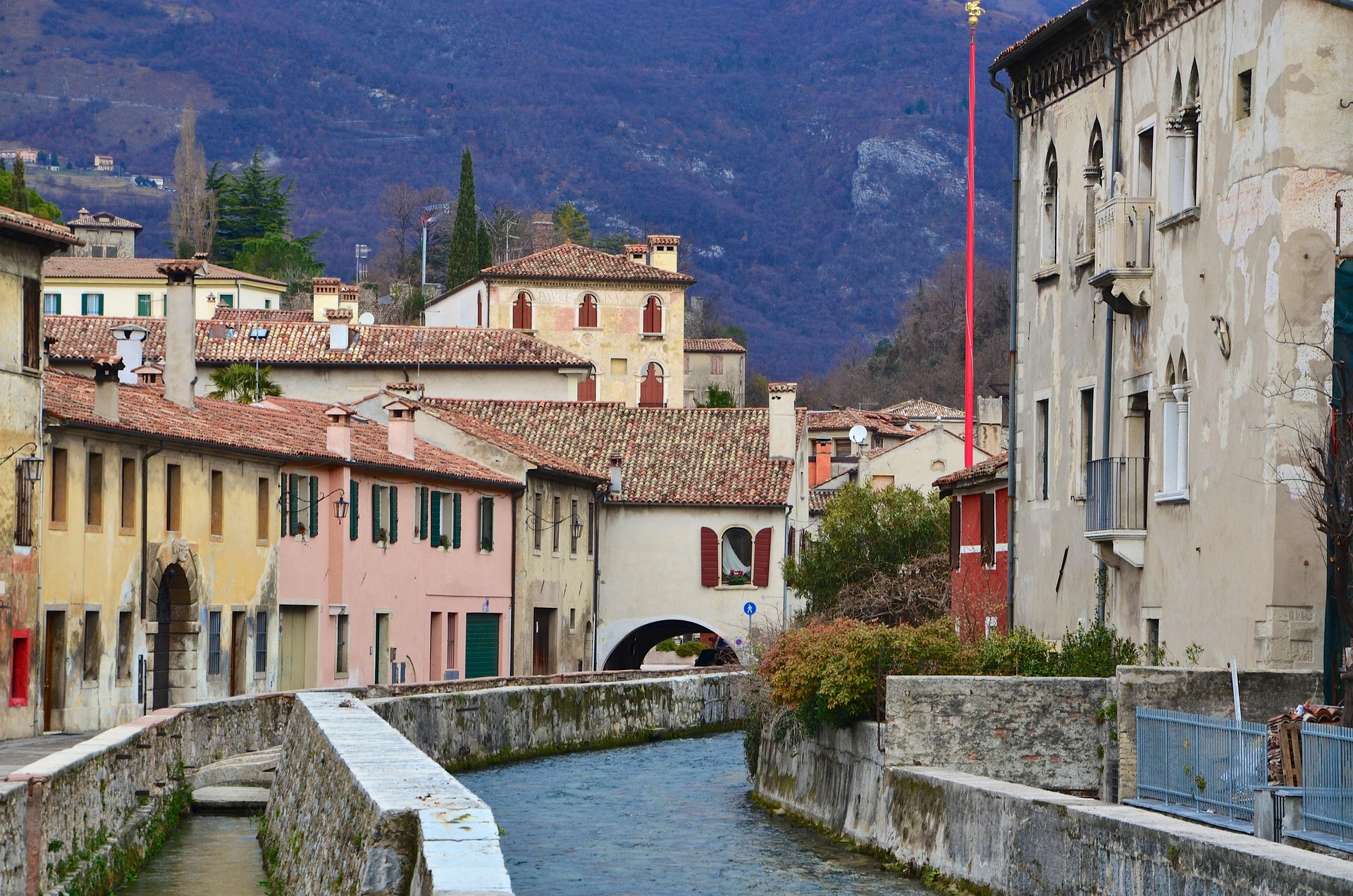
Serravalle, a short distance north along the Meschio River, was the merchant town, the place of trade and civic pride. Its historic centre is one of the most beautiful small urban spaces in the Treviso province — a long, arcaded piazza with Renaissance and Gothic palaces facing each other, a loggia that once served as the seat of political power, a river walk along the Meschio that reveals the town’s relationship with water and landscape in the way that the best Italian towns always do. In March, with the piazza quiet and the light clean and horizontal, Serravalle has the quality of a film set that hasn’t been discovered yet.
The town takes its name — Vittorio — from Vittorio Emanuele II, the first king of unified Italy, in whose reign the Veneto was finally incorporated into the Italian state in 1866 after centuries of Venetian and then Austrian rule. The addition of “Veneto” to the name came only in 1923, after the battle that would define the town’s identity for the rest of the century.
The Battle That Gave the City Its Name
On the morning of October 24, 1918, the Italian Army launched the offensive that would become one of the decisive military actions of the First World War. It was not a coincidence that the date was chosen: October 24, 1917 had been the date of the catastrophic Italian defeat at Caporetto, a battle in which the army lost 300,000 men — killed, wounded, or captured — and was forced to retreat from northeastern Italy in one of the most humiliating withdrawals in the war. The new offensive, launched exactly one year later under the command of General Armando Diaz, was designed as a direct reversal of that catastrophe. Diaz himself, when it was over, called it Caporetto in reverse.
The strategic logic was elegant. The Austro-Hungarian forces held a line across northern Italy that extended from the Adriatic coast through the Venetian plain, up into the foothills, and into the Alps. Vittorio — the town that would later become Vittorio Veneto — sat roughly at the midpoint of that line. If the Italians could take it, they would split the Austro-Hungarian army in two, separating the forces on the Adriatic plain from those in the mountain sector, and making a coherent defence impossible.
The opening phase of the battle was not easy. The Piave River, which the Italians needed to cross in strength, was in flood — an unseasonable October surge that threatened to make the river crossing impossible. At Monte Grappa to the west, the mountain assault was meeting fierce resistance and would ultimately cost the Italian forces nearly thirty thousand casualties in six days of fighting. The battle was not a walkover. It was hard, bloody, and uncertain in its early stages.
But on the Piave, the British 10th Army under Lord Cavan managed to establish a bridgehead, and from that point the campaign’s momentum shifted decisively. The Austro-Hungarian reserve units — soldiers from a dozen different nationalities within the empire, fighting for a political entity that was already visibly disintegrating around them — began to refuse orders. Czech and Slovak units were already aware that their provisional government in Prague had declared independence. Hungarian soldiers knew that Budapest was withdrawing from the union with Austria. South Slav troops understood that their future lay in a different state entirely. The Austro-Hungarian Empire was not simply losing a battle on the Piave. It was dissolving as a coherent political reality, and the soldiers could feel it.
On October 30, the Italian Eighth Army took the town of Vittorio. Two days later the Austro-Hungarian high command signed an armistice at Villa Giusti near Padua, to take effect at three o’clock in the afternoon on November 4, 1918 — a date that Italy still marks as the national day of victory and remembrance, the Giorno dell’Unità Nazionale. One week later, on November 11, Germany signed its own armistice on the Western Front.
The numbers tell the story of the campaign’s scale. The Austro-Hungarian forces suffered somewhere between 400,000 and 500,000 prisoners taken in those eleven days — one of the largest prisoner captures in the history of European warfare. Italian casualties, by contrast, were approximately 38,000 killed and wounded. The asymmetry reflects not just the battlefield outcome but the political collapse that was happening simultaneously: an army fighting for a state that no longer existed, against an army fighting for one that had just been redeemed.
The German General Erich Ludendorff, whose strategic judgement was generally clear-eyed about the war’s final phase, wrote afterward that in Vittorio Veneto, Austria had not lost a battle but lost itself — and in losing itself had dragged Germany into the fall. It was, in his assessment, one of the decisive events of the entire war.
The Museo della Battaglia
The Museo della Battaglia — the Battle Museum — is housed in the Bishop’s Palace in Ceneda, the lower town, and it is one of the most serious and emotionally honest war museums I know in northeastern Italy.
It does not traffic in triumphalism, which is the particular risk of museums dedicated to victories. It tries, instead, to give you a genuine experience of what the war was like for the people who fought it and the civilians who lived through occupation — and it does so through a combination of conventional museum display and something more visceral. There are recreated trench environments, with the sounds and smells of the front lines, that aim to put you inside the experience rather than simply presenting it from a distance. There are drawers of documents — letters, newspapers, official orders — from the occupation period, when the Austro-Hungarian Army controlled much of the Veneto and the civilian population navigated daily life under foreign military administration. There is a full account of the battle itself, its course and its consequences.
I bring guests here because I think it is important to understand what this landscape went through in the years between 1915 and 1918. The rolling hills between Treviso and the Dolomites that look, in March, like the most peaceful wine country imaginable, were a military front for three years. The Piave River, which you cross on the road north from Treviso, was the line that held. The villages between Treviso and Vittorio Veneto were occupied territory for part of that time. The families who own the vineyards where the Prosecco grows today had grandparents and great-grandparents who lived through all of it.
The museum makes that concrete. It earns the beauty of the landscape around it.
Lorenzo Da Ponte and the Other Vittorio Veneto
Before the battle gave the town its defining identity, Vittorio Veneto had another reason to be known, which is almost entirely absent from its current tourism story and which I find myself compelled to mention whenever I bring guests here.
Lorenzo Da Ponte — the librettist who wrote the Italian texts for three of Mozart’s greatest operas, Le nozze di Figaro, Don Giovanni, and Così fan tutte — was born in Ceneda in 1749, the son of a Jewish leather merchant who later converted to Christianity. He was educated here, ordained as a priest here, and spent his early years in the Veneto before a life of extraordinary adventure took him to Vienna, London, and finally New York, where he founded the first Italian opera house in America and taught Italian at Columbia University until his death in 1838.
The connection between this quiet episcopal town in the Treviso province and the creation of three of the most performed operas in the history of classical music is one of those Italian facts that rewards sitting with for a moment. Don Giovanni was premiered in Prague in 1787. Figaro opened in Vienna in 1786. The man who gave them their words, who shaped the dramatic structure that makes them work as theatre as well as music, grew up in the streets of Ceneda, looking at the same hills where the Prosecco vines now grow.
The town is officially recognised as a Città della Musica — a City of Music — in Da Ponte’s honour. There is a small museum dedicated to him. Most visitors don’t know any of this, which seems to me a significant oversight.
The Wine
Vittorio Veneto sits within the Conegliano Valdobbiadene Prosecco Superiore DOCG production zone — the hillside denomination that produces the finest Prosecco in Italy, inscribed by UNESCO as a World Heritage cultural landscape in 2019. The vineyards on the slopes above and around the town contribute to this denomination, and there are family producers in the Vittorio Veneto area whose wines are worth seeking out specifically, rather than simply as examples of the broader denomination.
The wine landscape around Vittorio Veneto in March has a particular quality. The vines are bare and the soil is visible — the clay, marl, and sandstone that give the Conegliano Valdobbiadene wines their distinctive mineral character show clearly in the freshly turned earth between the rows. The hills have a sculptural quality at this time of year, the terracing visible in full, the geometry of the vineyard rows describing the topography with a precision that summer foliage softens. A drive through the hills above Serravalle in March — through the villages and past the farmhouses where the Prosecco producers live and work, with the Dolomites visible to the north on a clear day — is one of the more quietly beautiful things you can do in this part of Italy.
The Prosecco Road, the Strada del Prosecco e dei Colli Conegliano Valdobbiadene, passes through this territory on its way between Conegliano and Valdobbiadene. If you are spending a day in Vittorio Veneto, the Prosecco Road gives you the natural route to follow through the wine country, with the option to stop at cantinas along the way. In March, as I have written elsewhere, the cellars are often at their most active — the second fermentation running in the autoclaves, the winemakers present and unhurried, the tasting experience more intimate than anything the summer crowds permit.
A Day in Vittorio Veneto in March: How I Would Structure It
I want to give you something concrete, because I know that American visitors planning a day trip from Treviso often want to know not just what exists but how to approach it.
I would start in Serravalle, arriving around nine in the morning when the light is at its best on the arcaded piazza. Walk the length of the main street — the old Via Regia, the royal road that connected Venice to the Dolomites and the northern trade routes — and spend time with the Gothic and Renaissance facades that line it. Walk down to the Meschio River and follow it for twenty minutes in either direction. The river walk is free, quiet, and entirely characteristic of this part of the Veneto: a functional waterway that powered mills and supported agriculture for centuries, now a linear park that gives you the texture of the landscape without requiring any effort to find it.
Then take the short drive or walk to Ceneda for the Museo della Battaglia. Give it at least an hour and a half. It rewards attention and does not rush you.
Lunch in one of the town’s osterie — ask where the locals go, which in Vittorio Veneto is still a question that produces a useful answer, because the tourist infrastructure here is thin enough that the restaurants serving good food are the ones that serve the people who live here. The kitchen will be Veneto — bigoli, risotto, meat from the hills, mushrooms if the season has produced them, and always Prosecco on the table.
The afternoon belongs to the hills. Drive up into the Prosecco country above Serravalle, follow the Prosecco Road through the villages, stop at a cantina if you can arrange it in advance, and end somewhere with a view of the valley below and the Dolomites beyond. In March, on a clear afternoon, the light goes warm around four o’clock and the landscape turns a colour that I find it difficult to describe — something between gold and ash, the bare vines and the pale clay and the distant snow on the mountains all visible at once.
Return to Treviso in time for the aperitivo hour, which in this province begins around six and is best observed at a bar in the historic centre with a glass of Prosecco Superiore from the hills you have just come through.
Why March Specifically
Vittorio Veneto in summer is pleasant but different. The Prosecco hills attract visitors in the warm months — cyclists, wine tourists, people drawn by the UNESCO designation — and the roads through the vineyards can be busy. The cantinas have their terraces full and the appointments sometimes feel like presentations rather than conversations.
In March, the town and the surrounding countryside are quiet in the way that Italian places are quiet when they belong entirely to the people who live in them. The museum has space to breathe. The piazza in Serravalle is occupied by people doing their daily business, not by tourism. The winemakers have time to talk. The light, as I have said, is remarkable — northern Italian spring light, clear and specific, with none of the haze that settles over the Veneto in July and August.
And there is something appropriate, I think, about visiting the site of a battle in the quiet months rather than the festive ones. The November 4 anniversary brings commemorations and official ceremony. March brings only the landscape and the history and your own attention. It seems to me the better way to encounter a place where something irreversible happened.
📩 I include Vittorio Veneto in my private day tours of the Treviso province, combining the historic town with a visit to Prosecco producers in the surrounding hills. If you would like to arrange a private tour that takes in the battle museum, the Serravalle historic centre, and a cantina visit, get in touch to discuss what you are looking for.
Frequently Asked Questions
How far is Vittorio Veneto from Treviso, and how do I get there?
Vittorio Veneto is approximately forty kilometres north of Treviso — about forty-five minutes by car on the A27 motorway or the older provincial road that runs through Conegliano. There is a train connection on the Venice-Belluno regional line, with the journey from Treviso taking around thirty to forty minutes depending on the service. However, for a day that includes both the town and the surrounding Prosecco hills, a car is strongly preferable — the cantinas and viewpoints that make the countryside worth visiting are not accessible by public transport. I would recommend driving from Treviso, following the A27 north and exiting at Vittorio Veneto, and planning to spend the full day in the area rather than rushing back. If you would prefer not to drive yourself, a private transfer or a guided tour with Igor removes the logistical question entirely and allows you to taste wine without the constraint of being behind the wheel. My day trips from Treviso regularly include Vittorio Veneto as part of a broader itinerary through the province.
Is the Battle Museum appropriate for visitors who are not specialists in military history?
Absolutely, and I would argue it is specifically designed for exactly this audience. The Museo della Battaglia at Vittorio Veneto is not a specialist military installation with display cases of weapons and detailed order-of-battle maps that require prior knowledge to make sense of. It is a narrative museum — one that tells a story about people, about what the war meant to the soldiers who fought it and the civilians who lived under occupation, about how a decisive military event shaped the political geography of an entire continent. The immersive elements — the recreated trench environment, the document drawers from the occupation period — work on a sensory and emotional level that doesn’t require you to know the difference between a division and a corps. What you need is curiosity and a willingness to give it time. I have brought guests of every background and level of historical knowledge to this museum and I have not yet met one who left unmoved.
Can I combine Vittorio Veneto with other destinations in the Treviso province in a single day?
Yes, and this is actually how I most often structure a day in this part of the province. Vittorio Veneto pairs naturally with Conegliano, which is twenty kilometres to the south and serves as the eastern anchor of the Prosecco Road — a town with its own medieval centre, its own Duomo containing a celebrated Giovanni Battista Cima altarpiece, and its famous School of Oenology founded in 1876, the first wine school in Italy. The two towns together, with a drive through the Prosecco hills connecting them, make a full and richly varied day from Treviso — history and wine and landscape in the correct proportions. You could also extend in the other direction: north from Vittorio Veneto the road climbs toward the Cansiglio plateau and eventually the Dolomites, and a day trip into the mountains is genuinely feasible from this part of the province if you are willing to commit to a longer drive.
Igor Scomparin is a licensed Tour Guide and Tour Leader for the Veneto Region, certified Travel Agency Director, and founder of tourleadertreviso.com. He has been featured in Rick Steves’ travel guides to Italy and Europe since 2008.