Is Treviso Worth Visiting? A Brutally Honest Answer from a Licensed Local Guide
I want to answer this question properly. Not the way travel websites answer it — with a list of adjectives and a stock photograph of the Buranelli Canal — but the way I would answer it if you sat down next to me at a bar in Piazza dei Signori and asked me directly, over a glass of Prosecco, whether you should bother coming here.
The short answer is yes. Emphatically, unreservedly, without caveats.
But the longer answer is more interesting. Because the real question is not whether Treviso is worth visiting. It is whether Treviso is the right city for you — and understanding the difference between those two questions will save you the disappointment that some travelers feel when they arrive expecting a quieter version of Venice and find something much stranger and more specific instead.
I am Igor Scomparin. I was born in this region, raised here, and have held an official Tour Guide License for the Veneto since 2007. I have been featured in Rick Steves’ travel guides to Italy since 2008. Treviso is not a city I studied in order to guide visitors through it. It is the city I grew up in. The river I walked beside as a child is the same river I show guests now. The market I describe to travelers is the same market where my family bought vegetables.
That is my qualification for answering this question honestly. Here is the answer.
First, Let’s Be Clear About What Treviso Is Not
Treviso is not Venice.
I say this not as a criticism but as a clarification, because the single most common source of disappointment among first-time visitors is arriving with Venetian expectations. The canals of Treviso are beautiful — the Buranelli Canal, in particular, is one of the most-photographed images in the Veneto — but they are small, quiet waterways running through a living city, not the improbable lagoon theatricality of the Grand Canal. There are no gondolas. There are no crowds of people photographing the same bridge from the same angle at the same time.
Treviso is also not Florence. There is no Uffizi. There is no Duomo that stops your heart the moment you turn a corner. The art in Treviso is extraordinary — the frescoes by Tomaso da Modena in San Nicolò and the Seminary are among the finest examples of pre-Renaissance Italian painting anywhere — but you have to know to look for them, and you have to be willing to stand in front of a fresco in a dark church and give it time.
Treviso is not Rome, not Siena, not the Amalfi Coast. If you come expecting a highlight reel of famous monuments and Instagram-ready panoramas, you will miss what the city actually is.
What Treviso is, is something rarer and in many ways more valuable than any of those things. But it requires a particular kind of traveler to see it.
So What Is Treviso, Exactly?
Treviso is a city that still belongs to the people who live in it.
That sentence sounds simple. It is not. In 2026, in the age of mass tourism, the number of Italian cities that can honestly make that claim is shrinking rapidly. Venice has largely been lost to tourism — not through any fault of the city itself, but through the sheer arithmetic of millions of visitors and a resident population that has been declining for decades. Florence’s historic centre is a museum district that happens to have restaurants. Rome’s most famous neighbourhoods have been colonised by Airbnb and souvenir shops.
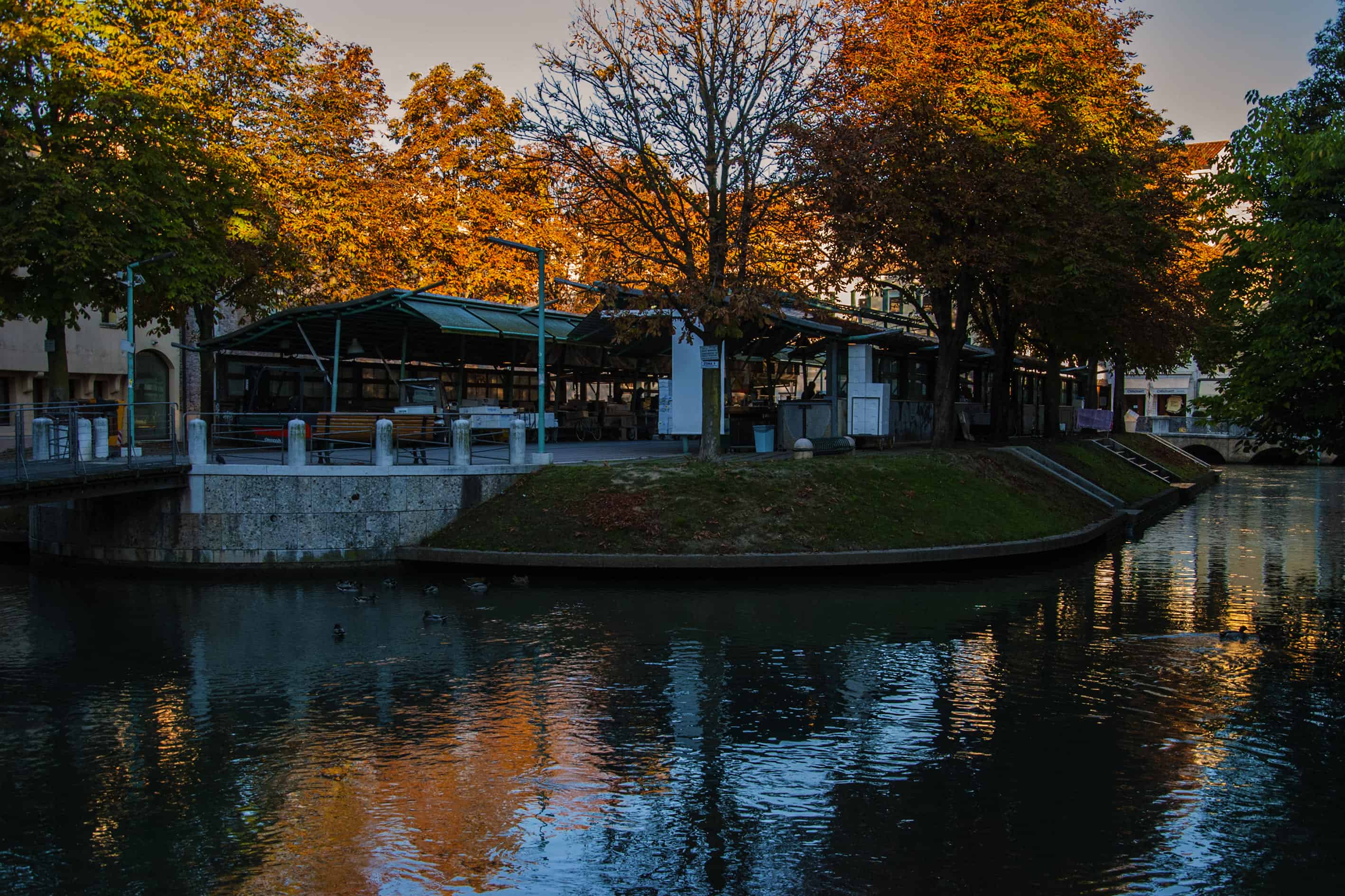
Treviso has not gone down that road. The city centre — the historic core inside the Renaissance walls built by the Venetian Republic in the sixteenth century — is a functioning city. People live there. They shop in the markets, eat in the osterie, argue in the piazza, walk their dogs along the canals in the evening. The bar at the corner of Via Calmaggiore has been serving the same regulars the same Prosecco for decades. The vegetable vendors at the Pescheria have been setting up before dawn since the market island was built in the nineteenth century.
When you walk into this city as a visitor, you are walking into a place that is not performing for you. That is either exactly what you want from Italy, or it is not. There is no middle ground.
The Honest Case For Treviso
Let me be specific about what makes Treviso genuinely extraordinary, because I think travel writing tends to reach for vague superlatives when concrete detail would serve better.
The food is among the best in Italy. I say this as someone who has eaten well across the country, and I say it without apology. The cuisine of Treviso is rooted in the specific ingredients of this territory — the Radicchio Rosso Tardivo IGP that exists nowhere else on earth, the Prosecco from the UNESCO hills twenty minutes north of the city, the freshwater fish from the Sile, the white asparagus from Cimadolmo, the baccalà that arrived via Venice’s trading empire and stayed because the Venetians knew what to do with it. The osterie and bacari of Treviso serve this food without theatrics, without tasting menus, without Instagram-friendly plating. You eat it at a wooden table with a carafe of local wine and you understand, perhaps for the first time, what Italian food actually is.
Treviso invented tiramisu. I know this is contested — everything in Italian food is contested — but the evidence points clearly to Le Beccherie, a restaurant in Treviso, and to the late 1960s. The dessert was created here, with local ingredients — mascarpone from the Veneto, espresso, savoiardi biscuits — by Ada Campeol, the owner’s wife, who deserves considerably more credit than she typically receives. You can eat tiramisu in Treviso in the knowledge that you are as close to the source as it is possible to get. I have written the definitive story of tiramisu’s Treviso origins if you want the full account before you visit.
The aperitivo culture is the best in Italy. This is a bold claim and I stand behind it. The spritz was perfected in Treviso — made with Aperol or Select, topped with local Prosecco, poured with a generosity that reflects the city’s fundamental attitude toward pleasure. The bacaro culture — the tradition of standing at a bar with a glass of wine and a small plate of cicchetti — is alive and daily here in a way that has nothing to do with tourism. Between six and eight in the evening, the bars along the canal fill with people who are there because this is what you do, in this city, at this hour. You are welcome to join. Nobody will stare at you.
The art is extraordinary and almost entirely undiscovered. The frescoes in San Nicolò by Tomaso da Modena are, I would argue, among the most psychologically sophisticated portraits painted in Europe before the fifteenth century. They are available to be seen, for free, in a church in a city that most art history courses do not mention. The Museo Civico houses an important collection of Venetian and Venetian-school paintings. The medieval frescoes on the exterior facades of many buildings in the historic centre — the painted arches, the decorative cycles, the remnants of a late medieval visual culture that was once the norm across northeastern Italy — are visible to anyone who walks slowly and looks up.
The surrounding territory is extraordinary. Treviso is not only the city. It is the base from which to understand the entire eastern Veneto — the Prosecco Road through the UNESCO hills, the hill town of Asolo where Caterina Cornaro held her Renaissance court, Bassano del Grappa with its covered bridge and its grappa distilleries, the Dolomites two hours north, the Sile River park that runs east from the city toward the lagoon. A week based in Treviso, with day trips radiating outward into the territory, is one of the richest itineraries available in northern Italy.
The Honest Case Against Treviso
I promised brutally honest, so here it is.
If you need famous monuments to feel that a trip is justified, Treviso will frustrate you. There is no single landmark here with the recognisability of the Colosseum, the Uffizi, or St Mark’s Basilica. The city rewards attention and slowness. Visitors who move through cities quickly, checking attractions off a list, will find Treviso thin. It is not thin — it is layered — but the layers only reveal themselves to people who stop and look.
If you are visiting Italy for the first time, Treviso may not be the right starting point. First-time visitors to Italy often need the big cities — Rome, Florence, Venice — to establish a reference point. Treviso makes most sense to travelers who have already seen the highlights and are ready for something more specific, more local, more genuinely Italian. I have seen guests arrive with Venetian expectations and leave underwhelmed. I have seen guests arrive knowing exactly what Treviso is — a living Veneto city with extraordinary food, real civic life, and art that nobody is queuing to see — and leave with the very specific grief of having to go home.
If your time in Italy is extremely limited — say, three days or fewer — and you have never been to Venice, go to Venice first. Treviso will wait. It has been here for two thousand years and it will still be here next time.
Who Treviso Is Perfect For
Here is my honest assessment, built on nearly two decades of showing this city to visitors from across the world.
Treviso is perfect for travelers who have been to Italy before and want to go deeper. For food and wine lovers who understand that the best Italian cooking is not in the famous restaurants but in the places that don’t need to advertise. For people who want to wake up in the morning and walk to a market and buy radicchio from the person who grew it. For cyclists, for walkers, for people who want to follow the cycling routes along the Sile through the countryside and arrive at a cantina where someone pours them a glass of Prosecco from the current vintage. For couples who want a genuinely romantic Italian city that has not yet been processed and packaged for tourism. For anyone who finds themselves in Venice and feels, amid the crowds and the queues and the selfie sticks, that there must be another Italy somewhere close by.
There is. It is thirty minutes away by train. It costs less to stay in, less to eat in, and offers more of the thing that most people actually come to Italy for — the sensation of being in a place with centuries of accumulated beauty and culture that is still, improbably, going about its daily life.
How to Visit Treviso Properly
Do not come for half a day. A half day in Treviso is like reading the first three pages of a novel and deciding you know how it ends. You will see the Buranelli Canal, take a photograph, eat a tourist tiramisu, and leave with a pleasant but shallow impression of a city that deserves better.
Come for at least two nights. Three is better. Two nights gives you two mornings — and the mornings are when Treviso is most itself, when the Pescheria is full and the city belongs to the locals and the light on the canals is doing something that no filter on any phone camera can quite capture.
Eat where the locals eat. Ask at your hotel which osteria the staff go to on their day off. Walk into a bacaro at six in the evening and order whatever the person next to you is having. Trust the seasonal menu. If it is winter, order the radicchio. If it is spring, order the asparagus. If you see baccalà mantecato on the menu, order it. If you see tiramisù made in-house, order it.
And if you want to understand the city properly — its history, its art, its food culture, its connection to the extraordinary territory that surrounds it — hire a licensed local guide. Not because the city is difficult to navigate, but because the difference between walking through Treviso and understanding what you are walking through is the difference between a pleasant afternoon and an experience that will stay with you for years.
📩 Get in touch and let me show you the Treviso that most visitors never see. I offer private walking tours of the historic centre, food and wine experiences, and fully customised multi-day itineraries across the Veneto.
Frequently Asked Questions
How much time do you need in Treviso?
My honest recommendation is a minimum of two nights, which gives you three days to explore at a proper pace. One day for the historic centre — the Pescheria in the morning, the churches and the canal walks through the day, aperitivo in the evening. One day for a day trip into the surrounding territory — the Prosecco hills, Asolo, or Bassano del Grappa depending on the season and your interests. And one day that you leave deliberately unplanned, because the best things that happen in Treviso are the ones that happen when you are not trying to make them happen. If you have only one day, use it well — read my guide to a full day of food in Treviso before you arrive — but know that you are getting the introduction, not the book.
Is Treviso better than Venice?
This is the wrong question, but it is the one everyone asks, so I will answer it. Venice is one of the most extraordinary human constructions in history. The Grand Canal, the Basilica di San Marco, the Doge’s Palace, the labyrinthine calli — these are experiences that exist nowhere else on earth and that genuinely justify the effort of getting there, even in high season, even with the crowds. Treviso does not compete with that. What Treviso offers is different: a city where the genius of the Venetian Republic expressed itself not in marble and gold but in the fabric of everyday life — in the markets, the osterie, the canal system, the city walls, the quiet streets that have barely changed in five hundred years. If you want spectacle, go to Venice. If you want Italy, come to Treviso. The ideal trip, of course, includes both.
What is the best time of year to visit Treviso?
Treviso is worth visiting in every season, but each season offers something specific. Winter — November through March — is the season of the radicchio IGP, and March in particular is my favourite month: mild temperatures, empty streets, the last radicchio of the season in every restaurant, and the first signs of spring beginning to appear. Spring — April and May — brings asparagus season, cycling weather, and the Prosecco hills at their most beautiful with the vines budding. Summer is warm and lively, with outdoor markets and long evenings for aperitivo along the canals. Autumn — September and October — brings the grape harvest, chestnut season, and the beginning of the radicchio cycle. The one honest caveat: avoid August if you want to eat well. Many of the best local restaurants close for the summer holiday.
Igor Scomparin is a licensed Tour Guide and Tour Leader for the Veneto Region, certified Travel Agency Director, and founder of tourleadertreviso.com. He has been featured in Rick Steves’ travel guides to Italy and Europe since 2008.